
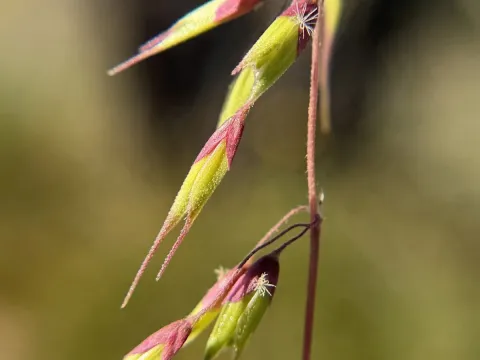
Ehrharta longiflora
Ehrharta longiflora
Ehrharta longiflora is an annual winter grass, making late autumn the ideal time for sowing to capitalize on the start of the wet season.
What the section contains
Ehrharta longiflora
The seeds are small and should be sown at a shallow depth of 1–2 centimeters to ensure effective germination and successful establishment in the seedbed.
Proper seedbed preparation, including the removal of competing vegetation, is essential for the crop to develop a uniform stand during its early growth stages.
In regions with unpredictable autumn rains, sowing should be timed to coincide with expected moisture to minimize the risk of seed desiccation.
The density of the sowing should be adjusted based on the intended use, whether for grazing, soil stabilization, or seed production purposes.
This species belongs to the Poaceae family and is highly recognized for its ability to thrive in poor, sandy, and nutrient-deficient soils.
It prefers Mediterranean-type climates, characterized by cool, wet winters and warm, dry summers, which aligns with its natural growth cycle.
Ehrharta longiflora exhibits significant drought tolerance, allowing it to survive in arid environments where other forage species might fail to produce biomass.
The plant requires well-drained soil and is highly intolerant of waterlogged conditions, which can lead to root damage and poor vegetative development.
While it is adaptable, providing a base level of nitrogen and phosphorus can significantly enhance biomass yields in managed agricultural settings.
Fungal diseases, including rusts and leaf spots, can affect the crop particularly during periods of high humidity or poor field ventilation.
Pests such as aphids and various cereal-attacking insects can cause damage to tender seedlings, requiring periodic field scouting by agronomists.
Weed competition is a significant concern during the establishment phase, as the growth rate of this grass is relatively slow in the first few weeks.
Overgrazing during the active growth phase can severely weaken the plant population and reduce its ability to reseed for the following season.
Integrated pest management strategies should be applied to prevent localized outbreaks that could negatively impact the overall quality of the forage.
The primary use of Ehrharta longiflora is for livestock grazing or green fodder, ideally harvested before the plant sets seed to maximize nutritional value.
Care must be taken to prevent the plant from becoming invasive, as its prolific seeding ability can lead to rapid spread if not managed correctly.
For high-quality hay production, the crop should be mowed while the foliage is still green and succulent, ensuring palatability for livestock consumption.
Seed harvesting should be performed promptly when the seed heads mature and turn color to minimize pre-harvest shattering losses in the field.
Post-harvest management often involves light grazing to reduce thatch buildup, which promotes healthy regrowth and improves soil surface conditions.