
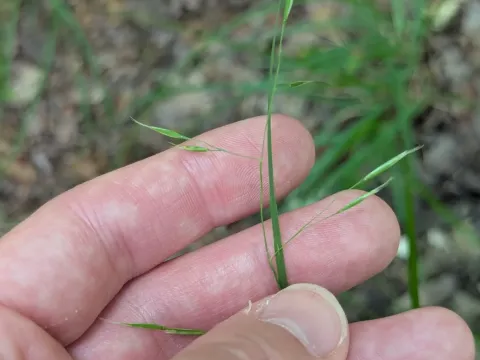
Flattened oatgrass
Danthonia compressa
Flattened oatgrass (Danthonia compressa) is a perennial grass species belonging to the Poaceae family. It is native to North America, primarily found in the eastern regions of the United States and Canada, where it thrives in open environments.
What the section contains
Flattened oatgrass
The species is well-adapted to dry, rocky, or nutrient-poor soils. It is frequently observed in open woods, along cliff edges, and on dry meadows where the competition for resources is relatively low compared to more fertile areas.
Botanically, it forms dense tufts or tussocks. Its culms typically reach heights between 30 and 80 cm, while its leaves are thin and often curled or involute. This structure is an adaptation to help the plant minimize water loss in arid environments.
Regarding climatic needs, Danthonia compressa requires well-drained locations with ample sun exposure. It is highly resistant to temperature fluctuations and does not tolerate saturated soil conditions, which can lead to root degradation.
In terms of agricultural and ecological use, this grass is valued for soil stabilization projects. It is an excellent candidate for land reclamation, especially on slopes prone to erosion, where its extensive root system helps to bind the soil particles effectively.
Fungal diseases such as rust and leaf spot are the most common threats to the health of the population, especially during periods of high humidity or unseasonable rainfall throughout the growing season.
Herbivorous insects, including various species of grasshoppers and aphids, may feed on the foliage. While these pests rarely destroy the entire population, they can reduce the plant's overall vigor in a competitive landscape.
Invasive species represent a major biological threat, as Danthonia compressa is a slow-growing grass. It can be easily displaced by more aggressive, non-native flora if the ecosystem is not managed properly or is disturbed.
Overgrazing by livestock is detrimental to the plant, as it removes the photosynthetic material before the plant can replenish its underground reserves, eventually leading to its eradication from the grazing area.
Soil pathogens, though less frequent in its preferred dry habitats, can occasionally become an issue if changes in drainage occur, making the root system more susceptible to environmental stress.