
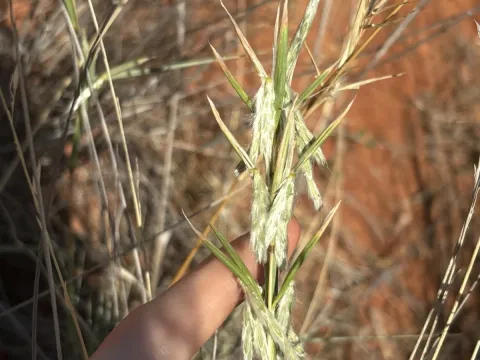
Silky oilgrass
Cymbopogon obtectus
Cymbopogon obtectus, commonly known as Silky oilgrass, is a resilient perennial member of the Poaceae family. It naturally forms dense, tussock-like structures that provide essential ground cover in various arid landscapes.
What the section contains
Silky oilgrass
The native range of this species is primarily across the Australian continent. It has evolved to thrive in environments characterized by heat, high light intensity, and significant moisture variability, making it a highly adaptive crop.
For successful growth, this grass prefers well-drained, sandy, or stony soils. It is remarkably tolerant of low-nutrient substrates and can even handle saline conditions that would be detrimental to many other agricultural crops.
Climatic requirements involve plenty of direct sunlight and minimal risk of waterlogging. The plant possesses physiological adaptations that protect it from drought stress, allowing it to maintain metabolic activity during hot, dry spells.
Botanically, the species is identified by its silky, hairy spikelets which give it a distinct appearance. The robust root system ensures the plant remains anchored and capable of nutrient uptake from deep soil horizons.
The primary economic value of Silky oilgrass lies in its essential oil potential. The leaves contain chemical components reminiscent of lemongrass, making them useful for both the fragrance industry and potential medicinal applications.
In extensive agricultural systems, this grass is utilized as a hardy forage plant. It serves as a vital feed source for livestock in arid regions during periods of drought when more sensitive pasture species fail to survive.
Harvesting for essential oil production requires careful timing. The peak concentration of aromatic compounds typically occurs during the full flowering stage, which serves as the optimal window for cutting the biomass.
Proper harvesting techniques are critical for sustainability. The grass should be cut at a specific height to avoid damaging the crown, thus allowing the plant to recover and regenerate rapidly for subsequent harvests.
Post-harvest handling is essential for maintaining product quality. Once cut, the biomass must be processed or distilled promptly to prevent the loss of volatile aromatic compounds that characterize this unique species.