
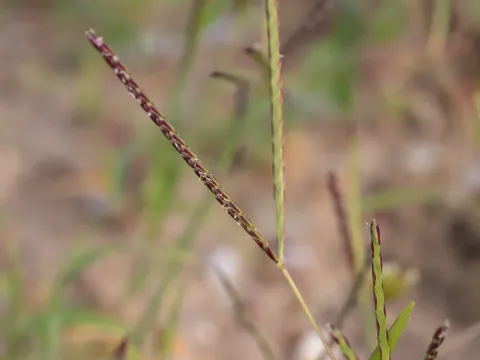
Simon's bermudagrass
Cynodon simonii
Simon's bermudagrass (Cynodon simonii) is a hardy perennial grass belonging to the Poaceae family. The successful establishment of this crop begins with thorough soil preparation, which involves removing competing perennial weeds and creating a fine, firm seedbed to ensure proper germination of the small seeds.
What the section contains
Simon's bermudagrass
The optimal sowing time occurs when soil temperatures are consistently above 15–18 degrees Celsius, which encourages rapid seedling emergence. In most climates, this aligns with late spring or early summer when the frost risk is negligible and solar radiation is high.
Seeds should be sown at a shallow depth of 1 to 2 centimeters. Because the seeds are tiny, it is critical to use a press wheel or roller after sowing to ensure intimate contact with soil particles, which helps in moisture retention during the critical germination phase.
Seeding rates typically range from 5 to 10 kilograms per hectare, depending on seed purity and local site conditions. Utilizing precision seeders helps achieve uniform plant distribution, which allows the crop to form a dense canopy quickly and reduces the need for manual weeding later on.
After emergence, the grass initially focuses on establishing its root and rhizome system. Once the plants begin to tiller, they spread laterally, forming a robust sod that is capable of enduring both mechanical harvest and periodic grazing pressure in subsequent seasons.
Simon's bermudagrass is highly adaptable to various soil types, ranging from sandy loams to heavier clay soils. However, it exhibits the best growth performance in soils with good drainage and a pH range between 6.0 and 7.5, ensuring optimal nutrient availability.
As a sun-loving species, this grass requires full sun exposure for maximum photosynthetic activity. Growth is significantly stunted in shaded areas, and it should be avoided near woodland edges or dense tree lines to prevent yield loss during the active growing season.
The species is renowned for its excellent drought tolerance, attributed to a deep and extensive root system. This trait allows it to maintain forage production even during prolonged dry spells, making it a reliable resource in regions prone to seasonal moisture deficits.
Nutrient requirements are moderate, but intensive management often involves split applications of nitrogenous fertilizers to promote lush vegetative growth. Phosphorus and potassium levels should be managed based on regular soil testing to ensure a balanced nutritional profile.
While tolerant to heat and dryness, the crop does not thrive in waterlogged or swampy conditions. Proper field leveling and, where necessary, the installation of tile drainage systems are essential to prevent root rot and promote healthy plant development throughout the year.
The yield of Simon's bermudagrass is heavily dependent on the level of management provided during the growing season. Under optimal irrigation and a balanced fertilization program, green matter yields can reach 20–30 tons per hectare, harvested in multiple cuttings.
Grazing management is a crucial factor in maintaining consistent biomass production. Implementing a rotational grazing system prevents overgrazing and allows the grass to replenish its carbohydrate reserves in the roots, ensuring rapid regrowth after the animals have been moved.
Nutritional value is a key benefit, as the forage produced by this grass is rich in crude protein and essential vitamins. Timely harvesting before the plants reach maturity is vital to maintain high quality and digestibility for cattle, sheep, and other livestock.
Seed production is an specialized aspect of cultivation that requires specific climate conditions and careful monitoring. The harvesting of seed crops is typically performed using combine harvesters adapted for small, light seeds during the late summer months.
The economic longevity of a Simon's bermudagrass stand is one of its primary advantages. Once established, the pasture can remain productive for several years, providing a consistent source of revenue or animal feed with minimal annual replanting costs.
Simon's bermudagrass possesses natural resistance to many common fungal diseases. However, in conditions of high humidity, particularly when foliage remains wet for extended periods, it may be susceptible to minor outbreaks of rust or leaf spot that require monitoring.
Insect pests such as aphids or grass-feeding caterpillars can occasionally reach threshold levels that necessitate control. Integrated pest management (IPM) strategies, including the use of beneficial insects and regular scouting, are preferred to maintain the ecological balance.
Soil-dwelling pests like wireworms or grub larvae can damage the root system, particularly in fields previously used for cereal crops. Preventive measures such as appropriate crop rotation and thorough soil cultivation before sowing help minimize the risks associated with these pests.
Weed management is most critical during the first few weeks after sowing. Using selective herbicides during the early growth stages effectively removes competition, allowing the bermudagrass to establish its characteristic dense cover that subsequently suppresses new weed germination.
Maintaining a healthy stand is the best form of defense against pests and diseases. Providing the correct balance of nutrients and avoiding physical damage to the sod through excessive machinery traffic helps keep the plants vigorous and resilient throughout the growing season.
Harvesting for hay should be timed for the early heading stage, which balances the quantity of biomass with nutritional quality. Cutting after the peak maturity period results in lower protein content and increased fiber, making the forage less palatable to livestock.
The hay drying process is best accomplished by using mower-conditioners that crimp the stems, accelerating moisture loss. Spreading the cut forage evenly and turning it frequently in the swath ensures a consistent drying rate under natural sunlight conditions.
Baling or stacking should be carried out when the moisture content is approximately 15–17 percent to prevent microbial spoilage. Stored hay must be kept in well-ventilated barns or under covers to protect it from rain and soil moisture which could cause mold.
When used as a pasture, the harvest is managed through controlled animal movement. Mechanical clipping might be required if patches of the pasture are left ungrazed, ensuring that all areas return to a vegetative state simultaneously and preventing seed head formation.
Seed harvesting requires technical expertise to ensure the seed is fully ripe and cleaned correctly. After threshing, the seeds need to be dried under controlled conditions to ensure viability and longevity during storage until the next planting season.