
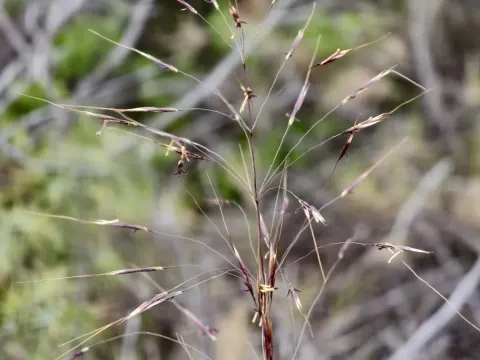
Chrysopogon gryllus
Chrysopogon gryllus
Chrysopogon gryllus, commonly known as a type of stink grass or golden-beard grass, is a perennial bunchgrass belonging to the Poaceae family. It is characterized by its deep, extensive root system which allows it to thrive in harsh, dry environments.
What the section contains
Chrysopogon gryllus
The species is native to Southern Europe, the Caucasus, and Central Asia. It typically occupies rocky, dry, or well-drained habitats where it can establish itself as a dominant member of the local plant community due to its drought tolerance.
Regarding soil requirements, the plant prefers calcareous or sandy substrates with neutral to slightly alkaline pH levels. It exhibits poor performance in waterlogged or heavy, poorly drained clay soils, which can lead to root degradation.
The climate requirements for Chrysopogon gryllus include high sunlight exposure and warm temperatures. It is well-adapted to Mediterranean-type climates with distinct dry seasons, showcasing resilience where conventional crops would fail.
Cultivation practices are minimal as the grass is highly self-sufficient. It is often employed in soil conservation projects to stabilize slopes and prevent soil erosion, thanks to its ability to develop dense, persistent root networks.
In agriculture, Chrysopogon gryllus is primarily valued as forage in extensive grazing systems. While not as nutritionally dense as cultivated hay crops, it provides essential cover and grazing for livestock in arid and semi-arid regions.
The forage quality is highest during the early vegetative stage. As the plant matures and produces its distinct golden-colored inflorescences, the palatability decreases as the leaves and stems become significantly more fibrous and woody.
Yield productivity is moderate and highly dependent on rainfall distribution throughout the growing season. In years of optimal moisture, it produces a sufficient amount of biomass to sustain low-intensity pastoral grazing.
It is rarely used for intensive hay production because the harvest timing is critical; if the grass is not cut early, the biomass quality drops sharply, making it less suitable for winter feed storage.
The long-term yield of this species is best expressed in its endurance. When included in perennial pasture mixes, it maintains stand integrity for many years, providing a reliable, long-term source of green forage in challenging locations.
Chrysopogon gryllus is remarkably resistant to many common fungal diseases that impact cereal crops. Its tough anatomical structure and high silica content contribute to its overall resistance against plant pathogens.
Insect pests are generally not a major concern for established stands. Occasional infestations of aphids or stem-boring insects may occur, but they rarely cause significant economic damage to the plant population at scale.
The primary threat to young stands is weed competition during the establishment phase. Proper land preparation and, in some cases, selective mowing during the first season are necessary to allow the seedlings to develop their root systems.
Root rot and crown diseases can appear if the plants are subjected to persistent moisture stress or flooding. Avoiding compaction and ensuring proper site selection are the most effective ways to prevent such issues.
For sustainable management, controlled grazing or seasonal mowing is recommended to keep the plant in its productive growth phase, which enhances its natural immunity and keeps the stand vigorous and resistant to pest pressure.