
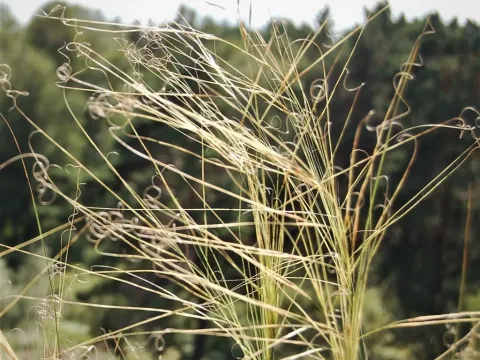
Feather grass
Stipa
Sowing of Stipa is typically conducted in the autumn, allowing the seeds to undergo natural stratification in the soil during winter. This process is crucial for achieving high germination rates and vigorous plant growth during the following spring season.
What the section contains
 Esparto grass
Stipa tenacissima Loefl. ex L.
Esparto grass
Stipa tenacissima Loefl. ex L.
 Green needlegrass
Stipa viridula Trin.
Green needlegrass
Stipa viridula Trin.
 Nassella tussock
Stipa trichotoma Nees
Nassella tussock
Stipa trichotoma Nees
 Needle-and-thread grass
Stipa comata Trin. & Rupr.
Needle-and-thread grass
Stipa comata Trin. & Rupr.
 Nees' needlegrass
Stipa neesiana Trin. & Rupr.
Nees' needlegrass
Stipa neesiana Trin. & Rupr.
 Stipa brachychaeta
 Godr.
Stipa brachychaeta
Stipa brachychaeta Godr.
 Stipa pulchra
 Hitchc.
Stipa pulchra
Stipa pulchra Hitchc.
 Stipa splendens
 Trin.
Stipa splendens
Stipa splendens Trin.
Feather grass
Alternatively, early spring sowing is feasible, provided it is done immediately after the snow melts. This timing utilizes the natural moisture stored in the soil, which is essential for the germination of feather grass seeds and the establishment of the initial root system.
The seeds should be planted at a depth of 2 to 4 centimeters. On heavier clay soils, a shallower depth is preferred, whereas on lighter, sandy soils, a slightly deeper placement helps prevent the seeds from drying out before they can germinate.
Seeding rates generally vary between 6 and 10 kilograms per hectare depending on seed quality. Using standard drills, farmers should aim for row spacing of up to 30 centimeters to avoid overcrowding and to allow each plant sufficient space to develop.
Post-sowing rolling is a recommended practice to ensure firm contact between the seeds and the soil. This measure improves moisture absorption and protects the relatively lightweight seeds from being displaced by strong winds common in steppe environments.
Feather grass, belonging to the Poaceae family, is a highly adapted perennial that thrives in arid and semi-arid conditions. It requires plenty of sunlight and does not tolerate competition from taller, shade-producing species within the canopy.
Regarding soil preference, Stipa is quite flexible, showing good growth on chernozem, chestnut, and even saline soils. The primary requirement is well-drained soil, as stagnant water is detrimental to the health and development of its root system.
The climate requirements include a continental pattern with hot, dry summers and cold winters. The plant is drought-resistant, utilizing its extensive root network to tap into deeper soil moisture reserves during prolonged dry spells.
Good agricultural practice emphasizes careful soil preparation, including deep plowing and thorough weed removal prior to planting. Since feather grass grows slowly during its first year, controlling surrounding vegetation is key to its establishment.
Fertilizer application should be managed cautiously, with an emphasis on potassium and phosphorus. Excessive nitrogen can lead to overly lush foliage that is more susceptible to disease and may reduce the plant's natural drought-hardiness.
The forage yield of Stipa is highly dependent on the harvest phase and environmental conditions. Maximum nutritional value is captured if the grass is harvested before it begins to seed, when the nutrient-to-fiber ratio is most favorable for livestock.
Average yields of dry matter typically range from 1.5 to 3.0 tonnes per hectare. Feather grass is often included in perennial forage mixtures, where it provides a stable green feed supply even during years when other crops suffer from severe drought.
Beyond forage, feather grass is valuable for soil conservation. Its dense root structure helps stabilize soil profiles, reducing the risk of erosion and improving soil structure, which is vital for maintaining long-term agricultural productivity.
Seed production yields vary based on weather conditions during the flowering stage. Harvesting for seeds requires precision timing to avoid significant losses caused by natural shattering, which is a common trait of the genus Stipa.
The economic efficiency of maintaining a feather grass field is high due to its perennial nature. It requires minimal annual input once the stand is established, making it a sustainable option for permanent pastures in marginal steppe lands.
Fungal infections, such as various types of rust and powdery mildew, represent the most significant threat to Stipa stands. These pathogens thrive in humid conditions and can significantly reduce the nutritional quality and biomass of the grass.
Insects like cereal flies and aphids can cause localized damage, particularly to younger, less established plants. Integrated pest management practices, including proper field hygiene and crop rotation, are effective in mitigating these threats.
Weeds are the primary competitor during the first year of growth. Because of the slow early development of feather grass, weeds can quickly overwhelm the stand, making manual or chemical intervention necessary to ensure the crop's survival.
Overgrazing is a major biotic factor that can lead to the decline of feather grass populations. Implementing a controlled grazing system allows the plant to recover and maintain its vigor throughout the growing season.
Preventative measures include using high-quality, treated seeds and maintaining a balanced nutrient level in the soil. Healthy plants are inherently more resilient and demonstrate a higher capacity to withstand the pressure of biotic stressors.
Harvesting Stipa for hay should occur at the full flowering stage. Delaying the harvest beyond this point results in higher stem lignification, which reduces both the digestibility of the forage and the voluntary intake by grazing livestock.
For seed production, harvesting is performed using combines with adjusted drum speeds to prevent mechanical damage to the delicate seeds. Timing is critical, with the harvest occurring at the onset of wax maturity to ensure viability.
Mowers are used to cut the biomass, which is then left in windrows to dry. Ensuring the grass is dried to an appropriate moisture level before gathering is essential for maintaining quality and preventing fermentation or mold development.
Once harvested, the material should be stored in dry, well-ventilated conditions. For seeds, maintaining a moisture content below 14% is mandatory to ensure the longevity of germination potential and to prevent the development of spoilage organisms.
Harvesting operations should be planned to avoid rainy weather, as moisture contamination significantly degrades hay quality and increases the risk of mold growth during storage, potentially making the forage unsuitable for animal consumption.