
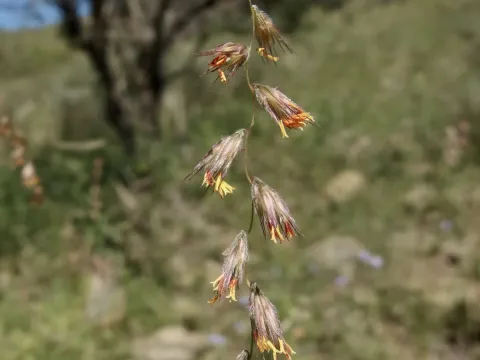
Bouteloua eludens
Bouteloua eludens
Bouteloua eludens is a warm-season perennial grass that is best sown in late spring once soil temperatures consistently reach 18-20 degrees Celsius to ensure rapid germination.
What the section contains
Bouteloua eludens
The seeds have moderate germination energy, making the period from mid-May to early June ideal for establishing the stand, allowing the plants to root before peak summer heat.
Seeds should be planted at a shallow depth of 1–2 centimeters, as they require a firm contact with moist soil to initiate the development of the primary root system successfully.
In arid climates, fall or winter seeding is recommended, as this allows the seeds to undergo natural stratification and germinate upon the first spring rainfall.
During large-scale planting, seeds are distributed uniformly using calibrated equipment to ensure optimal density and avoid overcrowding in the developed grass stand.
As a member of the Poaceae family, Bouteloua eludens exhibits high environmental plasticity and excellent resilience to dry conditions and low moisture availability.
The species thrives in well-drained sandy or sandy-loam soils with a neutral to slightly alkaline pH, typical of the landscapes in the Southwestern United States and Northern Mexico.
It possesses an extensive root system that allows for efficient water extraction from deep soil profiles, making it an excellent candidate for the restoration of eroded lands.
Optimal growth and biomass production require intense sunlight; excessive shading significantly reduces productivity and hinders the natural tillering process of the grass.
Soil aeration is a critical requirement, as the plant reacts poorly to waterlogging and soil saturation, which may trigger decay in the basal crown area of the grass.
Bouteloua eludens is primarily used as a high-quality forage grass for grazing lands and as a functional component in erosion control projects on unstable slopes.
Forage yield is highly dependent on grazing management; with controlled rotation, the grass recovers quickly and maintains productivity over many consecutive growing seasons.
In years with sufficient rainfall, the biomass productivity is high, providing a nutritious feed source that remains valuable even as the grass enters the flowering phase.
The nutritional content, particularly protein, remains relatively high compared to other native grasses, making it a preferred choice for improving range health.
When cultivated for seed production, yield is constrained by the biology of the spikes, requiring specialized harvesting equipment to ensure a successful collection of the grain.
Bouteloua eludens is generally resistant to local diseases, although improper agrotechnical practices can lead to fungal infections such as powdery mildew or various rusts.
Pests typical of grassy ecosystems can target the reproductive organs of the plant, which may negatively affect seed production potential during the peak summer months.
- Aphids that colonize young stems during periods of active growth.
- Soil-borne insects that become problematic under conditions of over-irrigation.
- Microscopic nematodes that can weaken the overall vitality of the stand.
To mitigate these threats, producers should maintain crop rotation and avoid monoculture planting, which prevents the build-up of host-specific pathogens in the soil.
Effective weed control during the seedling establishment stage is essential to prevent competitive vegetation from suppressing the young, slow-growing Bouteloua eludens plants.
Harvesting seeds requires high precision, as the spikes are prone to shattering upon reaching full maturity, which can lead to substantial yield losses if not timed correctly.
The ideal harvest time occurs when grain moisture content drops to 14-16 percent and the inflorescences take on a characteristic straw-like, golden hue.
For pasture usage, harvest is managed through rotational grazing systems, which minimize trampling impacts and facilitate the recovery of the aerial biomass.
Specialized headers with low-impact vibration are used during seed harvest to prevent shattering, ensuring that the maximum amount of seed is collected without mechanical damage.
Post-harvest, the seeds must be cleaned of debris and dried in well-ventilated areas to ensure high germination rates for future planting seasons.