
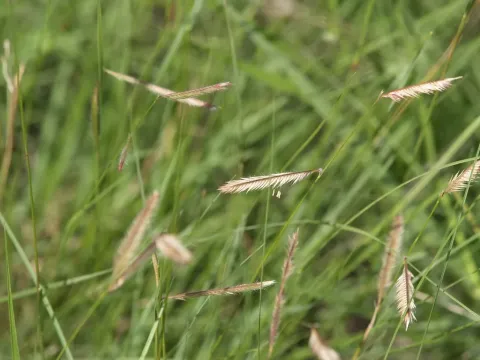
Bouteloua
Bouteloua
Bouteloua, widely represented by Bouteloua gracilis, is a warm-season perennial grass. The optimal time for planting is late spring or early summer when soil temperatures have consistently risen above 15°C.
What the section contains
 Black grama
Bouteloua eriopoda (Torr.) Torr.
Black grama
Bouteloua eriopoda (Torr.) Torr.
 Blue grama
Bouteloua hybr.
Blue grama
Bouteloua hybr.
 Blue grama
Bouteloua oligostachya (Nutt.) Torr. ex A. Gray
Blue grama
Bouteloua oligostachya (Nutt.) Torr. ex A. Gray
 Bouteloua repens
 (Kunth) Scribn.
Bouteloua repens
Bouteloua repens (Kunth) Scribn.
 Bouteloua rothrockii
 Vasey
Bouteloua rothrockii
Bouteloua rothrockii Vasey
 Buffalograss
Buchloe dactyloides (Nutt.) Engelm.
Buffalograss
Buchloe dactyloides (Nutt.) Engelm.
 Hairy grama
Bouteloua hirsuta Lag.
Hairy grama
Bouteloua hirsuta Lag.
 Sideoats grama
Bouteloua curtipendula (Michx.) Torr.
Sideoats grama
Bouteloua curtipendula (Michx.) Torr.
Bouteloua
Seeds should be sown at a shallow depth of approximately 1 to 2 centimeters. Proper seed-to-soil contact is crucial for germination, as the seeds require sufficient warmth and moisture to establish effectively.
For pasture establishment, drilling or broadcast seeding can be used. It is essential to ensure that the area is free of aggressive weeds, which could compete with the slow-growing Bouteloua seedlings.
In regions with hot, dry summers, planting shortly after the first seasonal rains can significantly boost establishment rates. Irrigation may be required only during the first few weeks after sowing.
Since the species is hardy, it establishes a robust root system within the first growing season. Once established, it requires minimal further intervention or maintenance from the farmer.
As a member of the Poaceae family, Bouteloua is native to the North American prairies. It is highly specialized for arid and semi-arid climates, thriving in areas where other grasses often fail.
This grass species requires full sun exposure to thrive. It is not shade-tolerant, and performance drops significantly when planted under trees or in shadowed locations where biomass production decreases.
Soil requirements are minimal. Bouteloua grows well in sandy, rocky, or low-nutrient soils, provided there is excellent drainage. Heavy, waterlogged soils are detrimental to its long-term survival.
The plant is highly drought-tolerant, utilizing its deep root system to scavenge for water. It can withstand prolonged dry spells that would typically cause other pasture grasses to go dormant.
Temperature tolerance is broad, allowing it to survive extreme winter cold. It is a very resilient species, often used in conservation efforts to prevent soil erosion in harsh environments.
Bouteloua is primarily used for range and pasture management in dry regions. It provides high-quality forage that remains nutritious even after the plant matures and dries in the field.
The grass is known for its ability to withstand grazing pressure better than many cool-season grasses. Its dense growth habit makes it an excellent choice for preventing soil degradation on livestock ranges.
While biomass yield is lower compared to intensive silage crops, its reliability in dry climates makes it an economically valuable forage choice. It serves as a sustainable feed source for cattle.
In urban and landscape contexts, Bouteloua is increasingly used as a low-maintenance, ornamental turf grass. Its slow growth rate means it requires infrequent mowing compared to traditional lawn species.
Harvesting for seed production should be performed when the characteristic eyelash-shaped seed heads reach maturity. Proper timing is key to maximize yield and prevent seed loss due to shattering.
Bouteloua has a strong natural resistance to many common agricultural diseases. It rarely suffers from major outbreaks, making it a low-input crop that does not typically require chemical treatments.
The main threats to the plant are usually linked to environmental conditions, specifically excessive moisture. Prolonged rain or poor drainage can lead to root rot or fungal leaf spots.
Insects and pests rarely cause significant economic damage to established stands. The tough texture of the leaves acts as a natural deterrent against many common forage pests and herbivores.
Weed management during the initial stages of seedling development is the most critical threat to successful establishment. Once the turf is closed, the grass is usually successful at suppressing most invasive weeds.
Overall, maintaining the proper soil structure and avoiding over-irrigation are the best strategies to keep the stand healthy and productive throughout its long lifespan.