
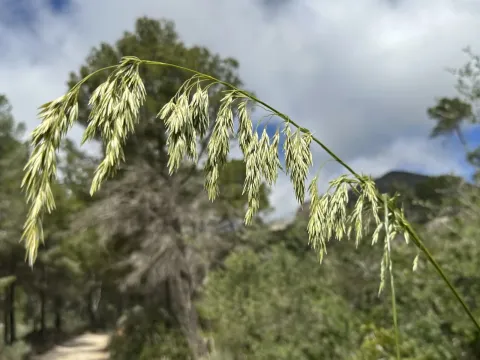
Ampelodesmos
Ampelodesmos
Ampelodesmos, specifically Ampelodesmos mauritanicus, is a prominent perennial grass belonging to the Poaceae family. This robust plant forms dense, tufted clumps that can reach heights of up to two meters, creating a distinctive presence in the landscape.
What the section contains

Ampelodesmos
Native to the Mediterranean basin, this grass thrives in diverse environments ranging from sunny hillsides to rocky outcrops. Its natural distribution spans across North Africa and Southern Europe, where it has adapted to warm, arid conditions.
The cultivation requirements for Ampelodesmos focus on its need for well-drained, nutrient-poor soils. It is highly drought-tolerant, making it an ideal candidate for reclamation projects in regions with scarce water resources and high levels of solar exposure.
Soil preferences include calcareous and sandy compositions, which support the plant's deep and complex root structure. It remains hardy in its native zone but struggles in regions with heavy, waterlogged clay soils or extreme winter freezing temperatures.
Agrotechnical management is simplified by the plant's hardy nature. Initial establishment requires patience as the grass develops its root system, but once mature, it serves as a self-sustaining crop that requires little to no chemical intervention or irrigation.
Ampelodesmos has historically been a significant source of fiber. The long, flexible culms are highly valued for their strength, which made them a staple in the production of traditional cordage, maritime ropes, and woven agricultural tools.
In modern settings, the plant is harvested to provide raw material for the pulp and paper industry. The biological properties of its fibers, which are rich in cellulose, make it a sustainable alternative to traditional wood-based pulp sources.
Erosion control is another vital use for this crop. Planting Ampelodesmos on steep hillsides helps stabilize the soil structure, preventing landslides and protecting the integrity of agricultural land in mountainous Mediterranean regions.
Harvesting techniques vary depending on the end-use, ranging from manual harvesting for artisanal crafts to mechanical mowing for industrial biomass processing. Optimal yield is achieved by harvesting in late summer to ensure maximum fiber maturity.
Recent interest has also turned toward biomass energy production. As a fast-growing perennial grass, it provides a renewable feedstock for pellet production, offering a viable solution for sustainable energy generation in its native growing zones.