
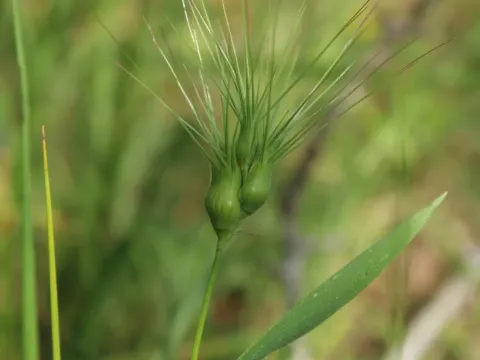
Aegilops geniculata
Aegilops geniculata
Aegilops geniculata, commonly known as oval grass or ovate goatgrass, belongs to the Poaceae family. This species is highly valued in agronomy as a wild relative of cultivated bread wheat, containing the D-genome crucial for breeding.
What the section contains
Aegilops geniculata
The plant originates from the Mediterranean basin and Western Asia. It is typically found in arid environments, rocky slopes, and disturbed habitats, showing a remarkable ability to colonize areas with poor soil quality.
Environmental requirements include a need for high solar radiation and resistance to drought. Unlike many crop plants, Aegilops geniculata flourishes in environments with irregular rainfall and significant temperature extremes.
Regarding soil preferences, the plant is not picky. It grows effectively in alkaline, heavy clay, or dry stony soils. Its deep root system allows it to extract moisture and nutrients efficiently even from degraded landscapes.
Its primary agricultural use is in experimental breeding programs. Scientists utilize its diverse gene pool to improve domesticated wheat varieties, specifically focusing on drought tolerance and resistance to various biotic stressors.
Aegilops geniculata is susceptible to common cereal pathogens, including stripe rust and leaf rust. Because it grows near wheat fields, it can act as a secondary host for these fungi, posing a risk to crop yields.
Insect pests such as cereal aphids and Hessian flies are known to colonize this grass. These infestations can weaken the plant's structural integrity and facilitate the entry of secondary viral infections.
Fusarium species and various root rots are major threats, especially when the plant grows in soils with poor drainage. These diseases cause stunted growth and significantly reduce the overall biomass of the populations.
Agricultural management requires rigorous weeding practices. Due to the high seed set and longevity of seeds in the soil, preventing its spread requires a combination of mechanical uprooting and chemical control.
Integrated weed management strategies often involve crop rotation cycles that include non-cereal crops, which helps break the lifecycle of the weed and reduces the pressure on wheat fields.