
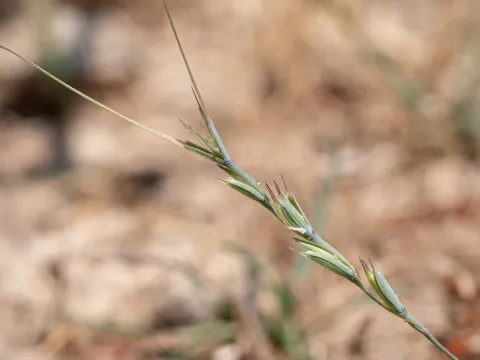
Aegilops caudata
Aegilops caudata
Aegilops caudata is primarily a wild species and is not grown commercially as a staple grain. In experimental agriculture, seeds are typically sown in the autumn to mimic the plant's natural growth cycle, allowing for a winter chilling period that stimulates germination.
What the section contains
Aegilops caudata
The optimal planting depth is approximately 2 to 4 centimeters. Shallow sowing is preferred to ensure that the seedlings, which are relatively delicate in the early stages, can emerge successfully without excessive energy expenditure.
When grown in field collections, the spacing should be sufficient to prevent competition for light and nutrients. Standard practice involves manual planting in rows to facilitate observation and ensure the purity of the genetic material.
No specific fertilizers are required in most research environments, as the species is highly adapted to low-fertility soils. Excessive nitrogen application can lead to lodging, which is detrimental to the development of the spikelets.
Sowing should take place in well-drained locations. Proper site selection is vital, as the species is highly sensitive to waterlogging, which often leads to poor stand establishment and fungal issues.
Aegilops caudata belongs to the Poaceae family and is native to the Mediterranean basin, the Middle East, and parts of the Caucasus. It is naturally found in arid, rocky habitats where few other cereals can survive.
The species exhibits remarkable tolerance to extreme environmental conditions, particularly drought. Its biological adaptations allow it to complete its growth cycle during the cooler, wetter periods of the year, effectively avoiding heat-induced stress.
Soil requirements are minimal. The plant thrives on alkaline, gravelly, and nutrient-poor soils. It is often used in studies focusing on the adaptation of cereal crops to marginal and degraded land environments.
Full sun exposure is a mandatory requirement for healthy development. The plant is heliophilic, meaning its photosynthetic efficiency drops drastically under any level of shade, which also impacts the fertility of the spikes.
Optimal growth occurs in climates with mild, moist winters and hot, dry springs. These conditions align with the phenological development of the species, ensuring timely maturity of the seeds.
In terms of agricultural output, Aegilops caudata provides a negligible yield of grain compared to Triticum aestivum. Its primary value lies in its genetic diversity rather than its capacity to provide food or feed.
The spikes are inherently fragile and undergo disarticulation upon maturity. This evolutionary strategy for seed dispersal makes mechanical harvesting impossible, as the seeds shatter and fall to the ground before they can be collected.
Yield estimation is mainly conducted in small-plot trials. Parameters such as spikelet number per spike and thousand-grain weight are measured to assess the potential of specific accessions for hybridization.
- Grain size: Small and elongated.
- Spike structure: Bristly and prone to shattering.
- Economic use: Exclusively for breeding and research.
Despite the low quantity of yield, the quality of its genome is highly prized. Breeders utilize it as a source of wild genes to improve the stress resilience and nutritional profile of modern wheat varieties.
This species is well-known for its high resistance to many prevalent fungal pathogens of wheat, including various forms of rust. This natural immunity is a key reason for its preservation in genetic germplasm banks.
Fusarium head blight remains a potential threat, especially if spring rains are prolonged. While the species is hardy, the dense nature of the spikes can trap moisture, creating favorable conditions for fungal development.
Insect pests such as aphids and cereal beetles may cause damage to young vegetation. However, the presence of stiff awns and tough glumes provides the plant with some level of structural defense against herbivory.
Weed management is critical during the seedling stage, as the plant grows slowly in the beginning and can be easily outcompeted by more aggressive invasive weeds or grasses.
The primary control measure in research settings is the application of strict phytosanitary protocols to prevent the spread of soil-borne pathogens or pests between distinct genetic lines.