
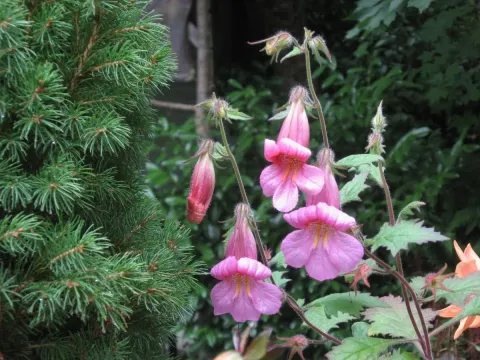
Rehmannia
Rehmannia Libosch. ex Fisch. et C.A. Mey
Sowing Rehmannia seeds is typically carried out in early spring, once soil temperatures stabilize between 15°C and 18°C. Because the seeds are minute, they are surface-sown and pressed lightly into the soil to ensure contact without burying them too deep.
What the section contains
 Rehmannia briscoei
Rehmannia x briscoei
Rehmannia briscoei
Rehmannia x briscoei
 Rehmannia elata
 N.E. Br. ex Prain
Rehmannia elata
Rehmannia elata N.E. Br. ex Prain
 Rehmannia glutinosa
 (Gaertn.) Steud.
Rehmannia hybrid
Rehmannia elata x Rehmannia glutinosa
Rehmannia glutinosa
Rehmannia glutinosa (Gaertn.) Steud.
Rehmannia hybrid
Rehmannia elata x Rehmannia glutinosa
 Rehmannia piasezkii
 Maxim.
Rehmannia piasezkii
Rehmannia piasezkii Maxim.
 Rehmannia piasezkii and Rehmannia elata
Rehmannia piasezkii x Rehmannia elata
Rehmannia piasezkii and Rehmannia elata
Rehmannia piasezkii x Rehmannia elata
Rehmannia
In temperate zones, a greenhouse approach is highly recommended. Starting seeds indoors in March allows for the development of sturdy seedlings that are ready to be transplanted into the field after the danger of frost has passed.
Maintaining consistent surface moisture is critical during the initial germination phase. If the soil surface dries out, the delicate embryos are prone to failure, which is why misting or covering the trays with plastic film is common practice.
Row spacing is generally set at 40 to 50 centimeters. This distance provides adequate room for the development of the foliage and ensures sufficient airflow around the plants, which helps mitigate the risk of fungal infections later in the season.
Pre-treatment of seeds, such as cold stratification for several weeks, can significantly improve germination uniformity, ensuring that a larger proportion of seeds sprout simultaneously under field conditions.
Rehmannia is a perennial herbaceous plant belonging to the Orobanchaceae family. Originating from East Asia, specifically China, it has been widely cultivated for centuries as a cornerstone of traditional herbal medicine.
The plant thrives in loose, well-draining soils rich in organic matter. A slightly acidic to neutral pH level is ideal. Heavy, compacted soils with poor drainage are highly detrimental as they restrict root development and lead to rot.
Regarding light, Rehmannia prefers bright, indirect light. While it can tolerate partial shade, full exposure to harsh afternoon sun can sometimes result in leaf scorching, particularly in warmer, drier regions.
Temperature management is vital; Rehmannia prefers moderate climates between 20°C and 25°C. In regions with severe winters, the root crowns require protection or should be lifted and stored in a frost-free environment until the following spring.
Water requirements are highest during the active growing phase. While the soil should be kept consistently moist, it must never remain waterlogged, as Rehmannia roots are extremely sensitive to low oxygen levels in the substrate.
The primary economic focus of Rehmannia cultivation is the root system, which is harvested after two growing seasons to ensure optimal accumulation of secondary metabolites, including glycosides and iridoids.
To maximize yields, nutrient management is essential. Incorporating well-composted organic matter before planting provides a steady supply of nutrients, while supplemental potassium during the second year enhances root thickening.
An average field yield ranges from 1.5 to 3 tons of dried raw material per hectare. These figures can fluctuate significantly depending on soil fertility, moisture availability, and the success of weed management programs.
Strict weed control is mandatory during the first year, as Rehmannia has a relatively slow growth rate and can be easily outcompeted by aggressive weeds, leading to a significant loss in potential biomass.
Processing the yield correctly—specifically cleaning and drying—determines the market quality. Roots must be handled gently to avoid bruising, which can lead to rapid oxidation and degradation of active chemical compounds.
Root rot is the most common threat to Rehmannia, often triggered by over-irrigation or soil compaction. Symptoms include chlorosis (yellowing of leaves) and sudden wilting of the stems due to necrotic root tissue.
Powdery mildew can affect the foliage during periods of high humidity and poor air circulation. This can be managed by ensuring proper plant spacing and applying preventative bio-fungicides when weather conditions are favourable for fungal growth.
Pests such as aphids and spider mites frequently attack the foliage, particularly during dry spells. These pests reduce the photosynthetic capacity of the plant, which directly impacts the carbohydrate storage in the roots.
Wireworms and other soil-borne larvae can cause direct damage by feeding on the taproots. Integrated pest management, including crop rotation with non-host species, is the most effective way to minimize these risks without excessive chemical use.
Field sanitation is of paramount importance. Removing dead plant matter at the end of the season prevents overwintering of pathogens that could infest the crop in the following year.
Harvesting usually takes place in late autumn when the aerial parts of the plant wither. At this stage, the plant has completed its cycle, and the roots reach their maximum weight and active ingredient content.
Mechanical harvesting must be done with caution. Using specialized blades that lift the roots without slicing them is preferred, as intact roots maintain their quality and medicinal value much better than damaged ones.
Post-harvest cleaning involves removing soil residues under running water. Once cleaned, the roots are often cut into segments to facilitate faster and more uniform drying, which is crucial for preventing mold formation.
Drying is performed in controlled environments at temperatures below 60°C. If the temperature is too high, volatile compounds are lost; if too low, the risk of rot during the drying process increases significantly.
Final storage must be in a cool, dry, and dark area to preserve the stability of the plant's phytochemical profile. Proper moisture control in the final product is key to its shelf life and future processing potential.