
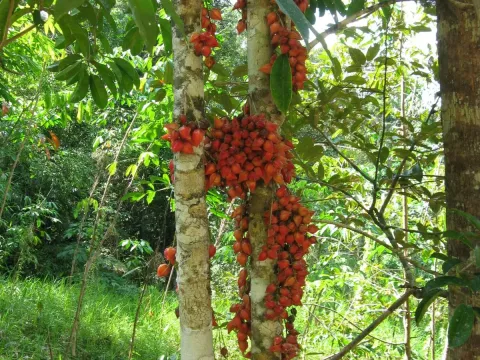
Baccaurea angulata
Baccaurea angulata
Baccaurea angulata is an evergreen fruit tree belonging to the Phyllanthaceae family, native to the tropical rainforests of Southeast Asia, particularly Borneo. The tree thrives in warm, humid climates where temperatures remain consistently high throughout the year.
What the section contains
Baccaurea angulata
The plant requires deep, fertile, and well-drained soils rich in organic matter to mimic the conditions of the tropical forest floor. Soil pH should ideally be neutral or slightly acidic for optimal nutrient uptake.
Water availability is the most critical factor for the growth of Baccaurea angulata. The tree demands high and constant soil moisture levels and does not possess traits required to survive even short, moderate drought periods.
In terms of light, young plants benefit from partial shade, protecting them from intense direct sun. As the tree matures, it becomes more tolerant to higher light intensity, provided the humidity levels remain sufficiently elevated.
Agricultural planning must prioritize protection from strong, drying winds, which can damage the tree's foliage and developing fruit. The species is strictly tropical and cannot withstand any degree of frost or cold weather stress.
The species exhibits cauliflory, a condition where flowers and fruits develop directly on the main trunk and large woody branches. The fruit is a distinctive red or purplish-red capsule with an angular, segmented shape.
Yield capacity is dependent on tree maturity and consistent soil moisture. In appropriate tropical environments, productive trees can generate significant yields, serving as a valuable seasonal food source for local communities.
The interior of the fruit consists of a translucent, juicy pulp surrounding the seeds. Its flavor is characteristically acidic to sweet, which makes it a popular ingredient in local beverages, jellies, and fresh culinary applications.
Cultivation is largely localized to traditional smallholdings and gardens. However, there is growing interest in the nutritional potential of the fruit, which contains antioxidants and vitamins, making it a viable candidate for specialized tropical fruit trade.
Agronomic monitoring of fruit development is essential. Because the fruit is susceptible to various physiological changes, professional orchard management focuses on maintaining plant vigor to ensure consistent, high-quality fruit size and flavor.
Harvesting is performed manually, as the fruit structure is delicate and prone to bruising if handled roughly. Careful harvesting is vital to prevent post-harvest rot and maintain the aesthetic quality of the red capsules.
Since fruit maturation is often asynchronous on a single tree, multiple harvest passes are usually required. This ensures that only fully ripened, high-quality fruit is picked, maximizing the total marketable yield for the season.
Post-harvest management involves placing the fruits in well-ventilated containers to prevent moisture buildup and fungal growth. The fruits are highly perishable and require immediate processing or distribution to local markets.
- Sort fruit immediately after harvest.
- Maintain high ambient humidity during storage.
- Avoid stacking containers too high to prevent mechanical damage.
Due to the short shelf life of the fruit, long-distance transport is challenging without advanced cold-chain logistics. Most agricultural operations for this crop are designed to support rapid supply chains to nearby urban centers.