
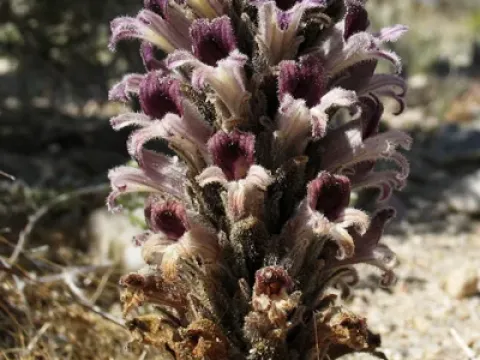
Cooper's broomrape
Orobanche cooperi
Cooper's broomrape is an obligate holoparasitic plant belonging to the Orobanchaceae family. As a non-photosynthetic organism, it lacks chlorophyll and relies entirely on external sources for its nutrition.
What the section contains
Cooper's broomrape
The native range of this species is primarily situated in the arid desert regions of the Southwestern United States and Northern Mexico. It is well-adapted to high temperatures and alkaline soil conditions.
The parasitic mechanism involves the development of specialized haustoria that penetrate the root system of host plants. This connection allows the broomrape to siphon essential water and nutrient compounds directly from the host's vascular tissues.
Growth requirements include the presence of suitable host species from the Asteraceae or Amaranthaceae families. In the absence of a host, the seeds can remain dormant in the soil seed bank for years, waiting for chemical signals.
Although it occupies a niche in natural ecosystems, Cooper's broomrape is considered a highly invasive and harmful entity when it encroaches upon agricultural land or protected native plant habitats.
The primary threat posed by this species is its massive reproductive potential. A single mature plant can produce thousands of minute seeds, which are easily disseminated by abiotic factors like wind and water runoff.
Management remains challenging due to the intimate physiological connection between the parasite and the host. Most chemical control measures risk damaging the crop plants alongside the parasitic weed itself.
Preventive strategies prioritize strict sanitation of farm machinery and equipment. Moving soil from infested areas to clean fields is the most frequent cause of new infestations in agricultural settings.
Biological control options are currently being researched, focusing on insects and soil-borne pathogens that target the root attachments. However, such methods are not yet widely available for broad-scale use.
The economic impact involves significant physiological stress on infected crops, resulting in stunted growth, chlorosis, and potential total yield failure in cases of heavy infestation density.