
Bartling's broomrape
Orobanche bartlingii
Bartling's broomrape (Orobanche bartlingii) is a member of the Orobanchaceae family. It is a holoparasitic plant, meaning it lacks chlorophyll entirely and relies exclusively on the host plant for water, minerals, and carbohydrates to complete its life cycle.
What the section contains
Bartling's broomrape
The species exhibits a high degree of host specificity, primarily parasitizing plants belonging to the genus Libanotis. This dependency determines the geographical distribution of the parasite, as it cannot survive in areas where its specific host plant is not present.
This plant is primarily found across various European regions, favoring open habitats such as dry meadows, steppe-like slopes, and forest edges. It thrives in well-drained soils that allow for deep penetration of the host's root system, which is essential for successful parasitism.
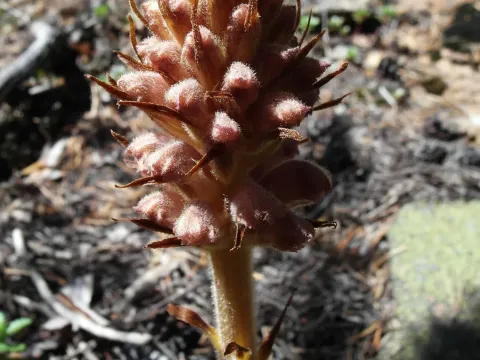
Botanically, Orobanche bartlingii presents as a vertical, unbranched stem characterized by scale-like leaves and a lack of green pigmentation. The flowers form a dense, spike-like inflorescence, varying in color from creamy yellow to soft shades of purple, which attracts specific pollinators.
The reproductive strategy of the species relies on the production of a massive quantity of microscopic seeds. These seeds remain dormant in the soil for extended periods, sensing chemical compounds secreted by the host's roots to trigger germination exactly when a food source is within reach.