
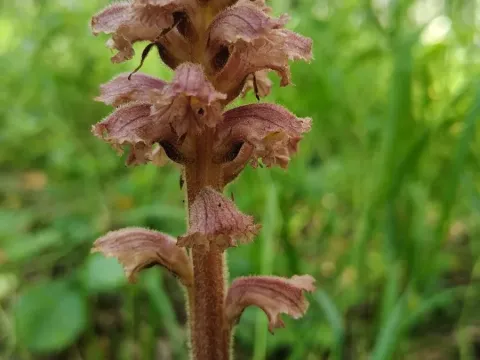
Alsatian broomrape
Orobanche alsatica
Alsatian broomrape (Orobanche alsatica) is an obligate root parasite belonging to the Orobanchaceae family. Being completely devoid of chlorophyll, it cannot perform photosynthesis and relies entirely on nutrients extracted from the root system of a host plant.
What the section contains
Alsatian broomrape
The distribution range of this species includes temperate regions of Europe and Asia. It typically colonizes various host plants within the Asteraceae and Apiaceae families, demonstrating high specificity to the chemical signals released by their roots to trigger germination.
Botanically, the plant appears as a fleshy stalk covered with scale-like leaves, emerging above ground primarily during its flowering stage. The majority of the plant body is subterranean, specialized into haustoria — organs that penetrate the host root to facilitate the transfer of water and assimilates.
Germination of Alsatian broomrape seeds is strictly dependent on the presence of chemical exudates from compatible host plants. Temperature and soil moisture levels are crucial factors, as seeds require specific environmental cues to remain viable and successfully attach to the host root.
There are no specific agrotechnical requirements for the growth of the broomrape itself, other than the presence of a host plant. Intensive farming practices that maintain continuous cultivation of susceptible hosts create ideal conditions for the propagation and establishment of this parasite in agricultural fields.
The primary threat posed by Alsatian broomrape is its direct impact on crop productivity. By acting as a nutrient sink, the parasite significantly stunts the growth of the host plant, resulting in reduced biomass, poor development of reproductive organs, and substantial yield losses.
Managing this parasitic weed is difficult due to its underground life cycle, which makes early detection almost impossible. Traditional cultivation techniques are often ineffective because removing the above-ground stalk does not damage the underground parasitic connection, allowing the parasite to potentially regrow.
Crop rotation is the most effective management tool. By replacing susceptible hosts with non-host crops for several consecutive seasons, the parasite is prevented from reproducing, gradually depleting the soil seed bank of the broomrape over time.
Chemical control options are limited and often rely on systemic herbicides applied during specific developmental windows. Furthermore, strict hygiene and phytosanitary measures are essential to prevent the spread of tiny broomrape seeds, which are easily transported by farm equipment, wind, and irrigation water.
Key mitigation strategies include:
- The selection of crop varieties with natural resistance or tolerance to broomrape attachment.
- Utilizing "trap crops" that stimulate seed germination without providing a viable host connection.
- Implementation of deep tillage to bury seeds beyond the effective depth for germination and host detection.