
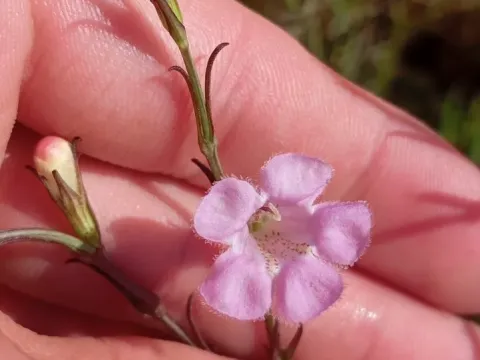
Agalinis
Agalinis
Agalinis is a genus of flowering plants belonging to the Orobanchaceae family. These plants are scientifically recognized as hemiparasites, meaning they possess chlorophyll and can produce their own energy through photosynthesis, while also extracting water and nutrients from host plants.
What the section contains
 Agalinis aphylla
Agalinis aphylla
Agalinis aphylla
 Agalinis divaricata
Agalinis georgiana
Agalinis georgiana
Agalinis divaricata
Agalinis divaricata
Agalinis georgiana
Agalinis georgiana
 Agalinis heterophylla
Agalinis heterophylla
Agalinis heterophylla
 Agalinis linifolia
Agalinis microphylla
Agalinis microphylla
Agalinis linifolia
Agalinis linifolia
Agalinis microphylla
Agalinis microphylla
 Agalinis obtusifolia
Agalinis obtusifolia
Agalinis obtusifolia
 Agalinis setacea
Agalinis setacea
Agalinis setacea
 Agalinis tenella
Agalinis tenella
Agalinis tenella
 Fascicled purple false foxglove
Agalinis fasciculata
Fascicled purple false foxglove
Agalinis fasciculata
 Gattinger's false foxglove
Agalinis gattingeri
Gattinger's false foxglove
Agalinis gattingeri
 Purple false foxglove
Agalinis purpurea
Purple false foxglove
Agalinis purpurea
 Saltmarsh false foxglove
Agalinis maritima
Saltmarsh false foxglove
Agalinis maritima
 Slender-leaf false foxglove
Agalinis tenuifolia
Slender-leaf false foxglove
Agalinis tenuifolia
 Thread-stalked false foxglove
Agalinis filicaulis
Thread-stalked false foxglove
Agalinis filicaulis
Agalinis
The morphology of Agalinis typically includes slender, branched stems and opposite leaves. Their flowers are often showy and tubular, appearing in shades of pink, purple, or white. This aesthetic appeal makes them significant components of wild prairie and meadow biodiversity.
Native primarily to the Americas, Agalinis species are adapted to diverse environments ranging from wet meadows and salt marshes to open grasslands. Their distribution is closely linked to the availability of suitable host root systems to which they can attach.
Regarding their growth requirements, these plants are highly specialized. They thrive in open, sun-exposed habitats where soil moisture is sufficient. Their dependency on a host plant means they cannot be easily cultivated in conventional farming or sterile potting environments.
Agalinis is not utilized as an agricultural crop. Because of its hemiparasitic nature, it is often studied in the context of grassland restoration and ecological preservation. Its presence is usually an indicator of a healthy, diverse ecosystem where specific plant-host interactions remain undisturbed.