
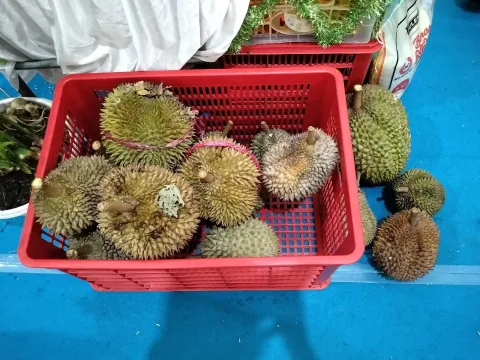
Durian
Durio
The durian (Durio) belongs to the Malvaceae family. Commercial propagation is primarily achieved through vegetative methods such as budding or grafting scions onto seedling rootstocks, which ensures the preservation of specific varietal traits.
What the section contains
 Durian excelsus
Durio excelsus
Durian excelsus
Durio excelsus
 Durio acutifolius
Durio carinatus
Durio carinatus
Durio acutifolius
Durio acutifolius
Durio carinatus
Durio carinatus
 Durio dulcis
Durio dulcis
Durio dulcis
 Durio graveolens
Durio graveolens
Durio graveolens
 Durio griffithii
Durio lanceolatus
Durio lanceolatus
Durio griffithii
Durio griffithii
Durio lanceolatus
Durio lanceolatus
 Durio lowianus
Durio lowianus
Durio lowianus
 Durio oxleyanus
Durio oxleyanus
Durio oxleyanus
 Kutai durian
Durio kutejensis
Kutai durian
Durio kutejensis
 Malacca durian
Durio malaccensis
Malacca durian
Durio malaccensis
 Singapore durian
Durio singaporensis
Singapore durian
Durio singaporensis
 Turtle durian
Durio testadinarum
Turtle durian
Durio testadinarum
 Wyatt-Smith's Durian
Durio wyatt-smithii
Wyatt-Smith's Durian
Durio wyatt-smithii
Durian
Seeds should be sown immediately after extraction from the fruit, as they rapidly lose viability upon drying. The germination medium must be loose, nutrient-rich, and possess excellent drainage characteristics.
Seedlings require protection from direct sunlight during their initial developmental stages. Planting in the permanent orchard location is ideally performed at the onset of the rainy season to ensure optimal root establishment.
Spacing between trees in a plantation should be at least 10–12 meters, as mature durian trees develop a wide, spreading canopy that requires significant space for light exposure.
Selecting the appropriate rootstock is critical, as it must exhibit resistance to soil-borne pathogens, which is a major limiting factor in humid tropical cultivation environments.
Durian is an strictly tropical crop requiring high atmospheric humidity (75–80%) and consistently high temperatures throughout the year, with an average range of +24…+30°C.
The plant is highly soil-sensitive; it thrives in deep, fertile loams or alluvial soils with a pH range of 5.5 to 6.5 that ensure efficient water drainage.
The trees absolutely do not tolerate waterlogging, which quickly results in root rot and plant death. Orchard sites must also be sheltered from strong, damaging winds.
Adequate annual rainfall (at least 1500–2500 mm) is necessary for healthy growth, although a short, distinct dry period is often required to trigger the flowering cycle.
- Regular application of organic fertilizers for soil enrichment.
- Monitoring groundwater levels (depth must exceed 1–1.5 meters).
- Mulching around the base to retain moisture during minor dry spells.
Grafted durian trees typically begin to bear fruit within 5–7 years after planting, whereas trees grown from seeds may require 10–15 years to reach reproductive maturity.
Flowering occurs once or twice per year, triggered by shifts in environmental moisture or temperature. Pollination is facilitated primarily by bats and various insect species.
The yield of a mature tree varies significantly based on variety and management practices, generally ranging from 50 to 150 fruits per season.
Individual fruits can weigh between 3 and 5 kilograms. Precise timing is essential for harvesting, as overripe fruits are prone to splitting and rapid spoilage.
Industrial productivity is directly linked to the health of local pollinator populations and the implementation of systematic structural canopy pruning.
The most devastating threat to durian cultivation is the fungal pathogen Phytophthora palmivora, which causes root and trunk rot, frequently leading to total tree loss.
Leaf-feeding pests, including various weevils and caterpillars, can significantly reduce photosynthetic capacity, thereby weakening the tree before the fruiting season.
Durian fruits are often infested by fruit borers, rendering the produce unmarketable and causing substantial economic losses for the grower.
In conditions of high humidity, fungal growth on the fruit skin is a common issue, making canopy aeration and proper sanitary pruning essential management practices.
Integrated pest management, including the use of targeted biopesticides and strict orchard hygiene, is necessary to maintain long-term crop productivity.
Harvesting is a critical operational phase, as the quality and organoleptic properties of the pulp are entirely dependent on the fruit's maturity at the time of harvest.
Most growers harvest fruits manually by carefully cutting them from the branches just before natural abscission, preventing physical damage caused by falling to the ground.
Maturity is assessed based on changes in skin color, a characteristic hollow sound when tapped, and the emergence of the intense, distinct aroma unique to each variety.
Post-harvest handling requires gentle transport, as the thorny husk is susceptible to bruising, which limits the shelf life of the exotic product significantly.
For international trade, durian pulp is often subjected to flash-freezing to preserve its unique texture and taste, allowing it to reach global markets in optimal condition.