
Malacca durian
Durio malaccensis
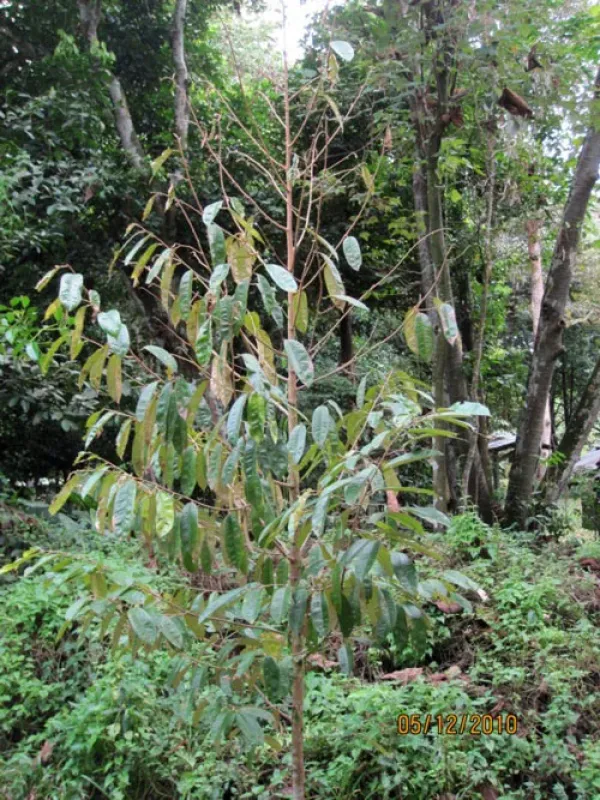
Description
Growing requirements
The Malacca durian (Durio malaccensis) is a member of the Malvaceae family. It is a large evergreen tropical tree native to the rainforests of the Malay Peninsula and Sumatra, thriving in humid, equatorial conditions.
The tree requires consistently warm temperatures, ideally between 24°C and 28°C, and cannot tolerate frost or temperatures below 15°C, which would severely inhibit growth and productivity.
High moisture levels are essential; the species thrives in regions with annual rainfall exceeding 2000–2500 mm. Proper water management is crucial, as the tree needs abundant water but lacks tolerance for waterlogged soils.
Deep, fertile, and well-drained loamy soils rich in organic matter are preferred for optimal development. Clay-rich soils require significant amendment to improve drainage and prevent root suffocation.
Agricultural management should focus on maintaining a humid microclimate, providing adequate spacing to allow air circulation, and performing regular organic mulching to preserve soil moisture and nutrient content.
Yield
The economic focus of Durio malaccensis is its fruit, which is highly prized for its unique aroma and rich, creamy texture. The fruit provides essential calories, proteins, and vitamins to local populations.
Trees grown from seeds typically begin fruiting at 7–10 years of age. Modern agricultural techniques, such as grafting, have successfully reduced this juvenile period to 4–6 years.
Yield capacity per tree depends on efficient pollination. In its natural habitat, the tree relies on bats and specialized insects for pollination, which is why preserving local biodiversity is vital for high yields.
Harvesting is performed by identifying fruits that have reached physiological maturity, usually indicated by a distinct change in scent and the development of abscission layers at the stalk.
Processing the harvest includes selling fresh fruits or extracting the pulp for use in traditional dishes, confectioneries, and preserved goods, which are popular in local and export markets.
Main diseases and pests
The most significant threat to durian orchards is root rot caused by the oomycete Phytophthora palmivora. This pathogen thrives in wet conditions and can devastate entire plantations if left unmanaged.
Fruit borers are common pests that attack developing fruits, leading to premature fruit drop and a significant reduction in marketable volume. Integrated pest management (IPM) is necessary to control these populations.
Fungal diseases like leaf blight and anthracnose are also prevalent in high-humidity areas. Regular monitoring and the application of fungicides are required to prevent widespread damage to the tree canopy.
Termites can attack the roots and stems of younger trees, necessitating regular scouting and the use of physical or chemical barriers to prevent structural damage to the trunk.
Nutrient deficiencies, particularly involving magnesium or iron, can manifest as chlorosis in leaves, reducing the plant's capacity for photosynthesis and lowering its stress resistance.
Harvesting
Harvesting Malacca durian requires careful timing to ensure the fruit reaches the consumer at the peak of flavor. Since the fruit is heavy and spiky, collection systems must prevent impact damage.
Large nets or cushioning structures placed beneath the tree canopy are often used to catch falling fruits safely, minimizing losses and maintaining the integrity of the tough outer rind.
Post-harvest management involves cleaning the fruits of debris and sorting them according to weight and appearance. Proper ventilation is needed during transit to manage the intense aroma and ripening process.
Cold storage is the primary method for extending the shelf life of the fruit. Freezing the extracted pulp has become a standard practice for international trade, allowing for stable supply chains.
Quality control at the harvest stage includes inspecting for premature splitting, which can lead to rapid bacterial contamination if not stored under strictly controlled hygienic conditions.