
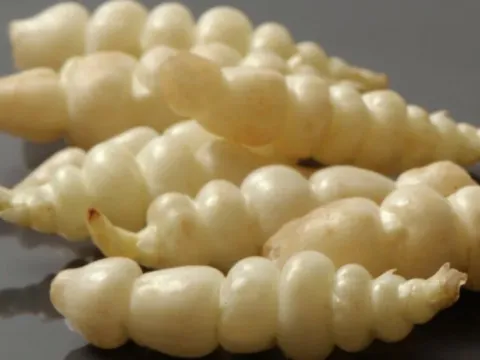
Chinese artichoke
Stachys tuberosus
Planting of Stachys tuberosus typically takes place in early spring once the risk of severe frost has passed and the soil begins to warm up significantly.
What the section contains
Chinese artichoke
The tubers are used as planting material and should be placed at a depth of approximately 5 to 10 centimeters into well-drained, prepared garden soil.
A spacing of about 30 centimeters between individual tubers is recommended to ensure each plant has enough room to spread its underground stolons.
It is important to select a location with full sun exposure, as shaded areas result in significantly lower tuber yields and weaker plant growth.
Early planting is essential to allow the plant enough time to establish a strong root system before the heat of mid-summer sets in.
As a member of the Lamiaceae family, this perennial requires loose, fertile, and well-drained soil to support the formation of its characteristic spiraled tubers.
The plant is sensitive to waterlogged conditions, which can lead to tuber rot; therefore, good drainage is a critical prerequisite for successful cultivation.
Stachys tuberosus thrives in temperate climates and needs regular moisture during the growing season to ensure optimal tuber size and quality.
Weed control is mandatory, as the plant is relatively shallow-rooted and competes poorly with aggressive weeds that can quickly overwhelm the crop.
Organic matter enrichment, such as aged compost, should be incorporated into the soil before planting to provide necessary nutrients for vigorous development.
Yield performance of the Chinese artichoke is strongly influenced by the soil structure and the amount of consistent moisture provided during the season.
On average, experienced growers can expect a yield of approximately 2 to 3 kilograms per square meter under favorable cultivation conditions.
The total weight of the harvest is determined by the proliferation of the underground stolons, which are stimulated by proper soil tilth and fertility.
Consistent care during the peak growing months directly correlates with the number of tubers harvested at the end of the season.
Producers should prioritize the health of the mother tubers, as they are the primary source of the next season's potential productivity and crop vigor.
Common issues include fungal pathogens that exploit overly moist soil conditions, often causing the tubers to deteriorate before harvest time.
Powdery mildew is a frequent foliar disease that appears as a dusty white coating on leaves, reducing the plant's ability to produce energy through photosynthesis.
Wireworms pose a significant threat to the crop, as they tunnel through the developing tubers, rendering them aesthetically unappealing and susceptible to secondary decay.
Slugs and snails can also cause damage to the young, tender foliage during the early stages of plant development, especially in damp, cool environments.
Integrated pest management, including crop rotation and ensuring good air circulation, is the best strategy to maintain a healthy and productive plot.
Harvesting is typically performed in late autumn or early winter, once the foliage has withered and turned yellow following the onset of the first cold weather.
One of the unique advantages of this crop is that the tubers can remain in the ground throughout the winter and be harvested fresh as needed.
For storage purposes, harvested tubers should be kept in a cool, humid environment, often buried in slightly moist sand to prevent them from drying out.
When harvesting, it is crucial to use garden forks carefully to lift the tubers out of the soil without damaging their delicate, thin skin.
Once harvested, tubers should be cleaned of soil debris and sorted to ensure that only the healthiest individuals are kept for consumption or replanting.