
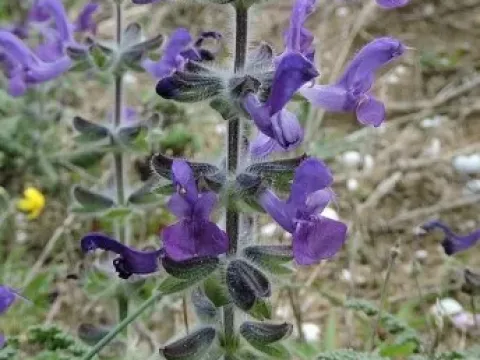
Woolly sage
Salvia lanigera
Woolly sage (Salvia lanigera) belongs to the Lamiaceae family and is recognized for its unique, dense hair-like covering on the foliage. This herbaceous plant is valued for both ornamental and aromatic properties.
What the section contains
Woolly sage
The optimal sowing time is early spring when soil temperatures reach at least 12 degrees Celsius. Proper seedbed preparation, including fine-tuning the soil structure, is critical for successful germination.
For industrial production, seeding is often done with precise equipment to ensure uniform depth. Given the small size of the seeds, they should be covered with only a thin layer of soil or fine compost.
Seedling production in climate-controlled facilities is an effective alternative, allowing for a longer growing season and better establishment of young plants before they are transplanted into the fields.
Adequate spacing is crucial to prevent competition between plants. A typical layout includes rows set 50–60 cm apart, allowing sufficient air movement and space for machinery or manual maintenance.
As a xerophyte, Salvia lanigera is naturally adapted to arid and semi-arid conditions. It thrives in regions with low precipitation and high solar radiation, making it suitable for sustainable farming in dry climates.
The crop requires full sun exposure to maximize the concentration of volatile compounds in its leaves. Areas with high shade coverage will result in lower oil yields and poor quality of the raw plant material.
Well-drained, sandy-loam soils are ideal for woolly sage cultivation. The soil pH should ideally be neutral or slightly alkaline, as the plant does not tolerate waterlogging or acidic conditions.
Minimal fertilization is required, as the plant is adapted to nutrient-poor soils. Excessive nitrogen can lead to lush vegetative growth but reduces the plant's resistance to environmental stress.
The plant is resilient to temperature fluctuations, which is typical for its native habitat in the Middle East. However, protection from prolonged frost is necessary in colder cultivation zones to ensure crop survival.
Harvesting usually occurs at the beginning of the flowering stage, when the concentration of essential oils is at its peak. This timing ensures the best quality for pharmaceutical or cosmetic applications.
Manual harvesting is often preferred for high-value applications to ensure that only the most mature and healthy leaves and inflorescences are collected, avoiding contamination with stems or weeds.
Mechanical harvesting is feasible on large plantations using specialized forage harvesters. It is important to adjust the height of the cutting bar to avoid damaging the crown of the plant for future regrowth.
Immediate post-harvest processing, such as drying in ventilated areas or specialized dryers, is essential. Rapid drying prevents fermentation and the loss of aromatic components sensitive to high heat.
Yields depend significantly on environmental conditions, soil fertility, and agricultural management. Efficient harvesting techniques can help maintain the crop's longevity and maximize production over multiple seasons.