
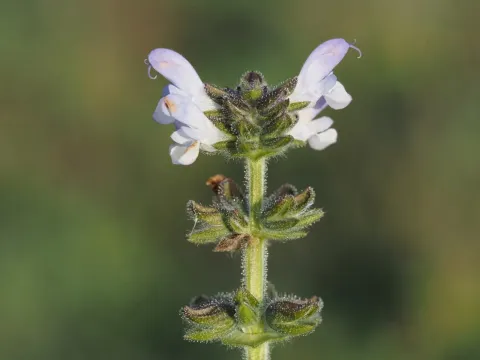
Wild clary
Salvia verbenaca
Wild clary (Salvia verbenaca) is a hardy perennial herbaceous plant belonging to the Lamiaceae family. For successful cultivation, seeds are typically sown in early spring once the soil temperature consistently reaches 10-12 degrees Celsius.
What the section contains
Wild clary
In regions with milder winters, autumn sowing is also a viable option, allowing for early spring germination as soon as weather conditions permit. The seeds should be planted at a shallow depth of 1–2 centimeters, as they require light exposure to trigger optimal germination.
Once seedlings emerge, thinning is essential to ensure adequate space for root development and leaf expansion. A standard spacing of 45 to 60 centimeters between rows is recommended to facilitate mechanical weeding and proper air circulation.
To improve germination rates, it is advisable to soak seeds briefly in water before sowing, especially if the seeds were stored for a long period. This treatment helps to stimulate the embryo and ensure a more uniform emergence of the plant population.
The plant exhibits significant self-seeding capabilities, which, if managed correctly, allows for the maintenance of a stable crop stand over several years without the need for constant re-sowing or frequent soil disturbance.
Wild clary thrives in open, sunny locations with well-drained, fertile loamy or sandy soils. It is notably drought-tolerant, making it an excellent candidate for agricultural systems in regions with unpredictable rainfall or arid climates.
Proper drainage is the most critical environmental requirement; the species is sensitive to waterlogged conditions, which can lead to root rot and diminished plant vigor. The soil pH should ideally remain neutral or slightly alkaline for optimal growth.
Originating from the Mediterranean region and Western Europe, the plant is well-adapted to temperate climates. In areas prone to harsh winter frosts, providing mulch or protective covering can safeguard the perennial rootstock from damage during the dormant season.
The crop is highly attractive to pollinators, including bees and butterflies, which enhances the overall ecological health of the farm. From the second year onwards, the plant becomes quite competitive and is often effective at suppressing local weeds.
Maintenance includes regular inter-row cultivation to break soil crusts and promote gas exchange in the root zone. This is particularly important during the spring growth flush to ensure the plant reaches its full biomass potential.
The economic value of wild clary is primarily derived from its biomass, which contains essential oils, and its seed production. Yield levels depend heavily on soil fertility, moisture availability during the growing season, and the overall health of the plant population.
During the first year, yields are generally lower as the plant invests energy into building a robust root system and a basal leaf rosette. Optimal biomass productivity is typically achieved from the second year and persists through the third or fourth year.
The essential oil extracted from the leaves and inflorescences is used in the fragrance, medicinal, and culinary industries. Due to its unique chemical profile, there is a steady demand for high-quality, sustainably harvested plant material.
Managing the harvest for seeds requires careful timing to prevent natural dispersal. Growers often use mechanical harvesters when the seed pods are fully mature but before the seeds have completely shed from the spikes.
Regularly harvesting the flowering spikes during peak bloom can stimulate the plant to produce secondary growth, potentially increasing the total seasonal yield of vegetative material under favorable moisture conditions.
Slugs and snails are the most common pests, particularly affecting young plants in damp or high-humidity conditions. Biological control methods, such as encouraging natural predators or using physical barriers, are preferred over chemical interventions.
Powdery mildew and various leaf spot pathogens are the primary threats, especially in overcrowded or poorly ventilated fields. Good management practices, including appropriate spacing and regular scouting, are essential for effective prevention.
Root rot, caused by excessive moisture, remains a major risk in heavy clay soils. Ensuring excellent drainage through soil amendments or raised beds is the best strategy to mitigate this threat effectively.
While wild clary possesses natural secondary metabolites that discourage many herbivores, occasionally aphids or weevils may infest the flower stalks. Regular monitoring allows for early detection and targeted management of any localized outbreaks.
Adhering to crop rotation principles and maintaining spatial isolation from related species helps prevent the build-up of specific soil-borne pathogens, ensuring the long-term sustainability of the field.
Vegetative material should be harvested at the beginning of the flowering stage, when the concentration of volatile compounds and essential oils is at its highest level in the plant tissues.
Harvesting is usually done by cutting the stems 5–10 centimeters above the ground. Proper post-harvest handling, such as rapid drying in a shaded, well-ventilated space, is vital to preserve the vibrant color and quality of the leaves.
For seed collection, growers wait until the seed pods on the lower portion of the inflorescence turn brown. Harvesting in dry weather is crucial to prevent molding during storage and to facilitate cleaner seed processing.
After collection, the seeds must be thoroughly cleaned and dried to a moisture content of 10–12%. Maintaining this moisture level ensures viability and longevity during storage until the next planting season.
Post-harvest residues can be effectively utilized as compost, adding valuable organic matter back to the soil, provided that the plants were free from any significant disease pressure at the time of harvesting.