
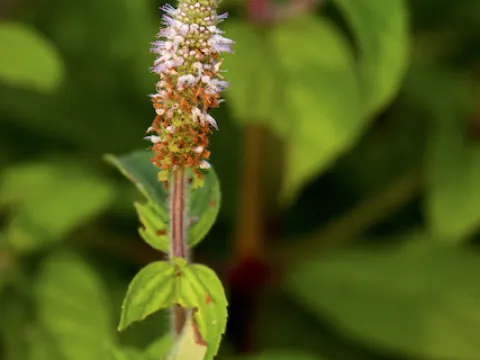
Pogostemon auricularis
Pogostemon auricularis
Pogostemon auricularis is a perennial herbaceous plant belonging to the Lamiaceae family. It is typically found in wet habitats, and its propagation in cultivation is primarily achieved through stem cuttings rather than seeds.
What the section contains
Pogostemon auricularis
For optimal growth, cuttings should be planted in a nutrient-rich, moist substrate. The best time for propagation is during the active growth phase in late spring, ensuring the soil temperature remains consistently warm.
When starting from seeds, they should be scattered on the surface of a prepared seedbed, as they require light to germinate effectively. The substrate must be kept constantly moist and protected from direct evaporation.
Establishment of the crop requires stable conditions. Once the young plants have developed a robust root system, they can be transplanted to their final location, ensuring adequate spacing of about 25–30 cm between plants.
Successful sowing requires avoiding cold drafts and ensuring the growth medium remains at a slightly acidic to neutral pH, which is ideal for this specific species of Pogostemon.
This plant is classified as a moisture-loving species. It naturally thrives in wetland environments, along riverbanks, and in marshy areas, meaning its agronomic needs are heavily tied to consistent water availability.
Pogostemon auricularis requires fertile, loamy soil with high organic content. The soil must have good water-retention capacity to satisfy the plant's high transpiration rates during the day.
Lighting is a critical requirement for this crop. It performs best in bright, indirect sunlight. Low light intensity leads to legginess and reduced biomass production, which is undesirable for harvesting.
The ideal temperature for cultivation ranges from 22°C to 28°C. Being of tropical origin, the plant is sensitive to cold temperatures and cannot tolerate frost, which makes greenhouse cultivation necessary in temperate zones.
Maintaining high air humidity around the plants is as important as soil moisture. This helps prevent leaf tip burn and encourages vigorous foliage development, which is the primary economic target for this crop.
The primary threats to Pogostemon auricularis are soil-borne diseases such as root rot, which are exacerbated by waterlogged, stagnant conditions. Ensuring good drainage is essential to mitigate these risks.
Pests like spider mites are common, especially in dry greenhouse environments. Regular inspection and the maintenance of high humidity are effective cultural controls against these infestations.
Leaf-eating insects can cause significant cosmetic and growth damage. When these pests are present, using targeted, low-toxicity interventions is recommended to preserve the medicinal value of the leaves.
Fungal pathogens causing leaf spots may appear if air circulation is insufficient. Increasing ventilation and avoiding overhead irrigation can help maintain a healthy canopy and reduce disease outbreaks.
Integrated pest management, involving the monitoring of plant health and the prompt removal of diseased sections, remains the most effective strategy for ensuring a stable yield.
The harvest cycle for Pogostemon auricularis begins when the plant enters the flowering phase. At this time, the concentration of essential oils and active metabolites is typically at its peak.
Harvesting involves cutting the aerial parts of the plant, leaving a small portion of the stem intact to promote regenerative regrowth. Multiple harvests per season are possible under favorable conditions.
Post-harvest, the plant material must be dried carefully in a shaded, well-ventilated area. Rapid drying at controlled temperatures prevents the degradation of delicate aromatic compounds.
Yield efficiency is highly dependent on nitrogen availability during the vegetative stage. Proper fertilization schedules ensure that the plants recover quickly after each harvest cycle.
Storage of the finished product should be in airtight, light-resistant containers. This preserves the quality of the harvested biomass for distribution or medicinal processing for extended periods.