
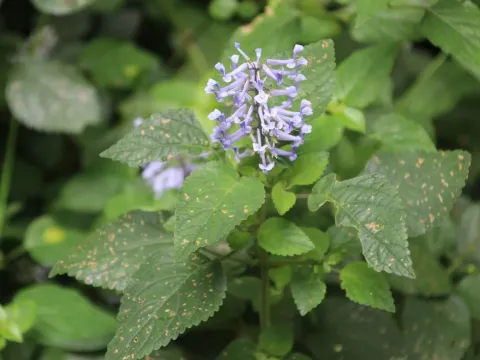
Plectranthus
Plectranthus L’Hér.
Propagation of Plectranthus in agricultural and horticultural settings is primarily performed through stem cuttings. This method ensures that the desirable characteristics of the parent plant are maintained in the new generation.
What the section contains
 Coleus
Plectranthus scutellarioides (L.) R. Br.
Coleus
Plectranthus scutellarioides (L.) R. Br.
 Coleus caninus
Plectranthus ornatus
Coleus caninus
Plectranthus ornatus
 Hybrids of Plectranthus saccatus and Plectranthus hilliardiae
Hybrids between Plectranthus saccatus and Plectranthus hilliardiae
Hybrids of Plectranthus saccatus and Plectranthus hilliardiae
Hybrids between Plectranthus saccatus and Plectranthus hilliardiae
 Plectranthus ciliatus
 E. Mey.
Plectranthus ciliatus
Plectranthus ciliatus E. Mey.
 Plectranthus fruticosus
 L'Her.
Plectranthus hilliardae
Plectranthus hilliardae
Plectranthus hybrid shrub
Plectranthus fruticosus L'Her. x P. oertendahlii T. C. E. Fr.
Plectranthus fruticosus
Plectranthus fruticosus L'Her.
Plectranthus hilliardae
Plectranthus hilliardae
Plectranthus hybrid shrub
Plectranthus fruticosus L'Her. x P. oertendahlii T. C. E. Fr.
 Plectranthus oertendahlii
 T. C. E. Fr.
Plectranthus parviflorus
Plectranthus parviflorus Willd.
Plectranthus oertendahlii
Plectranthus oertendahlii T. C. E. Fr.
Plectranthus parviflorus
Plectranthus parviflorus Willd.
 Plectranthus purpuratus
 Harv.
Plectranthus purpuratus hybrid
Plectranthus purpuratus Harv. x P. strigosus
Plectranthus purpuratus
Plectranthus purpuratus Harv.
Plectranthus purpuratus hybrid
Plectranthus purpuratus Harv. x P. strigosus
 Plectranthus saccatus
 benth
Plectranthus saccatus
Plectranthus saccatus benth
 Plectranthus strigosus
Plectranthus strigosus
Plectranthus strigosus
Plectranthus
The ideal time for taking cuttings is during the active growth phase in late spring. Softwood cuttings should be kept in a moist, well-draining rooting medium until a robust root system develops.
Seed propagation is also possible, although it is less common due to the small size of the seeds. Seeds are sown on the surface of a light soil mix and kept under consistent temperature conditions.
High humidity and temperatures around 20–25 degrees Celsius are critical during the early stages of development. Once the seedlings have reached a sufficient size, they are transplanted into individual pots.
To maximize yields in a greenhouse environment, it is necessary to provide adequate spacing to prevent crowding and ensure consistent light exposure for every plant in the crop rotation.
Plectranthus, a member of the Lamiaceae family, requires bright, indirect sunlight to thrive. While the plant is quite adaptable, harsh, direct afternoon sun can scorch its foliage.
The soil should be fertile, loose, and slightly acidic to neutral in pH. Excellent drainage is non-negotiable, as Plectranthus is highly susceptible to root rot in saturated, stagnant soil conditions.
Temperature management is vital, with an ideal range of 18–25 degrees Celsius. The plant is sensitive to frost, which limits its outdoor cultivation to tropical or frost-free climates.
Regular watering is required to maintain soil moisture, allowing the surface to dry out slightly between irrigations. In drier climates, misting the plants can help maintain the necessary ambient humidity.
Fertilization with a balanced, water-soluble fertilizer every two weeks during the growing season supports the development of lush, fragrant foliage, which is the primary value of the crop.
Spider mites are the most common pest, especially in low-humidity environments. They cluster on the underside of the leaves, causing stippling, discoloration, and eventual leaf death.
Mealybugs can also pose a significant threat, appearing as white, cotton-like masses on the stems. These pests weaken the plant by feeding on the sap, requiring timely insecticidal soap application.
Root rot is the most prevalent disease, generally triggered by overwatering or poor drainage. Once established, this condition is difficult to treat, often necessitating the removal of the affected plant.
Powdery mildew may occur when ventilation is poor and humidity remains consistently high. Improving air circulation is the most effective cultural method to prevent the spread of fungal spores.
Integrated pest management strategies, including the use of neem oil or targeted biological controls, are recommended to maintain plant health while minimizing chemical residue in the final product.
The harvest of Plectranthus foliage is timed to capture peak oil production, which usually occurs just before the plant enters its full flowering stage.
Plants are harvested by pinching or cutting the top few inches of the stems. This act of pruning serves a dual purpose by ensuring a high-quality harvest and encouraging denser, healthier lateral branching.
Post-harvest processing involves air-drying the leaves in a cool, dark, and well-ventilated space. Slow, controlled drying is essential to prevent the loss of volatile essential oils.
Once dried, the leaves are stored in airtight, opaque containers to protect them from light and moisture degradation, preserving their fragrance and chemical properties for market distribution.
The final product is utilized across various sectors, including the fragrance industry, culinary arts, and as a natural source for botanical extracts used in wellness and pharmaceutical formulations.