
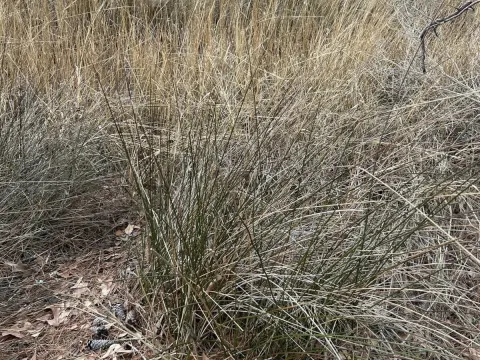
Needle rush
Juncus roemerianus
Needle rush is a perennial grass-like plant that primarily spreads through underground rhizome expansion in its native coastal environment.
What the section contains
Needle rush
For large-scale restoration projects, propagation is often achieved through greenhouse-grown seedlings rather than direct field seeding.
The seeds require specific stratification and consistent high-moisture levels to ensure successful germination and seedling establishment.
Transplanting mature seedlings into tidal sites should be timed with the early spring to maximize root development before the peak heat.
Proper spacing during installation is crucial to allow the rhizomes to interlock and form a resilient protective mat against tidal currents.
As a member of the Juncaceae family, Juncus roemerianus is a hallmark species of salt marshes across the Atlantic and Gulf coasts.
This species is highly adapted to saline environments and can withstand prolonged periods of inundation by brackish or salt water.
The plant thrives in full sun but maintains sufficient health in partial shade, provided that soil moisture remains high throughout the day.
It acts as a primary producer in coastal wetlands, playing a critical role in trapping sediments and maintaining the structural integrity of the shore.
It prefers deep, saturated, fine-textured soils where it can develop its characteristic rigid and dense colony structures.
Needle rush is not harvested for food or fiber, as its primary value lies in its ecosystem services rather than agricultural production.
Its productivity is measured in terms of biomass accumulation, which prevents coastal erosion and provides habitat for diverse marine life.
The dense colonies are highly effective at sequestering carbon, contributing to the development of organic peat in coastal marsh environments.
It serves as a nursery ground for various fish and crustacean species, proving its worth as an ecological resource for marine conservation.
The ability of this species to stabilize dynamic shorelines makes it an essential component of modern ecological engineering strategies.
The needle-like, rigid leaves covered with a waxy cuticle provide excellent natural resistance against most common agricultural pests.
The greatest threats to the species are human-induced, including shoreline development, dredging, and alteration of natural hydrology.
While remarkably hardy, the species can be outcompeted by invasive non-native vegetation if the salinity balance of the marsh is disrupted.
Severe soil contamination or significant drops in water levels can lead to the decline of established stands over several growing seasons.
Pathogenic outbreaks are rare in wild populations because the highly saline and oxygen-saturated environment of the marshes inhibits fungal growth.
Harvesting for commercial purposes is virtually nonexistent due to the low forage quality and the mechanical toughness of the stalks.
When management necessitates the thinning of dense stands for canal maintenance, heavy-duty amphibious equipment is typically required.
Collected biomass is occasionally utilized for high-quality mulch, though it requires heavy shredding to break down the fibrous material.
Prescribed fire is the most common management tool, often used to clear dead biomass and promote vigorous new growth in the spring.
Small-scale artisanal harvesting occurs for basketry and weaving, where the strength and rot-resistance of the dried stems are highly valued.