
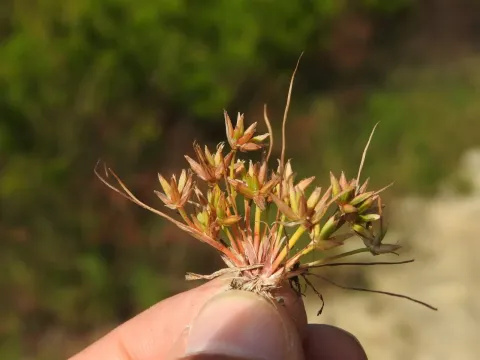
Pygmy rush
Juncus pygmaeus
The Pygmy rush (Juncus pygmaeus) belongs to the Juncaceae family. It is a small annual herbaceous plant specifically adapted to moist environments, often found in ephemeral wetlands and sandy depressions that experience seasonal inundation.
What the section contains
Pygmy rush
Originating from Mediterranean and Western European regions, this species thrives in niches where competition from tall grasses and perennial sedges is low. Its distribution is highly dependent on climate stability and moisture availability.
Cultivation requires specific environmental conditions. It demands consistently moist soil and high light intensity to complete its reproductive cycle. Unlike many agricultural crops, it does not require fertile soils but rather thrives in mineral-rich, often acidic, sandy or silty substrates.
Water management is the most critical aspect of its agrotechnology. The substrate must remain damp throughout the growing season, though it tolerates short dry spells if the groundwater level remains accessible to the root system.
In terms of land use, Juncus pygmaeus is utilized primarily for ecological restoration projects. Its ability to colonize disturbed moist sites makes it a valuable component for stabilizing temporary waterlogged soils and enhancing local biodiversity.
The primary threats to Juncus pygmaeus involve habitat loss due to land drainage and environmental changes. As an annual, it is particularly sensitive to sudden shifts in the hydrological cycle during its germination phase.
Fungal diseases are a concern in high-humidity environments, especially when air circulation is poor. Symptoms typically manifest as leaf lesions or stem decay, which can be mitigated through proper spacing and management of site density.
Herbivory can pose a problem in areas where local wildlife or livestock grazing is unregulated. The plant's small stature makes it vulnerable to being crushed or overgrazed, which severely impacts its ability to produce seeds for the next season.
Invasive species represent a major biological threat. More robust, fast-growing hydrophytes can easily outcompete the Pygmy rush for light and nutrient resources if the site is not properly managed.
Chemical runoff from nearby intensive farming poses a significant risk to populations. Nitrogen-rich water promotes the growth of competitive vegetation, which eventually leads to the disappearance of Juncus pygmaeus from the area.