
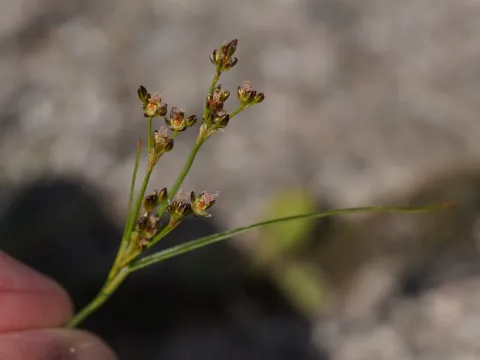
Round-fruited rush
Juncus compressus
Round-fruited rush (Juncus compressus) is a perennial herbaceous plant belonging to the Juncaceae family. It is a rhizomatous species that thrives in dense clumps, often forming large colonies in moist and wet environmental conditions.
What the section contains
Round-fruited rush
Native to temperate regions of Europe, Asia, and North America, this plant is commonly found in floodplains, wet meadows, marshes, and sometimes on saline soils near water bodies.
The plant requires high soil moisture levels and can tolerate periodic flooding for extended periods. It is highly adapted to salt-affected substrates, making it a valuable bio-indicator for specific meadow ecosystems.
Optimal growth is achieved in sunny, open areas. It does not tolerate heavy shade, and its presence significantly decreases in forested areas or dense canopies, where it eventually fails to develop flowers.
In agricultural practice, it is often utilized for its ability to stabilize loose or wet soils. The root system effectively anchors the ground, preventing soil erosion in areas vulnerable to water-related degradation.
The economic utility of Juncus compressus is primarily limited to its role in natural pastures. It is not considered a high-performance crop but serves as part of the total vegetation on damp meadows.
Cattle and sheep consume the young shoots readily; however, the plant becomes fibrous and tough as it matures. Once the stems lignify, the forage quality decreases significantly, making it less suitable for hay.
Average yield of green biomass varies significantly based on water availability. On managed meadows, it can contribute to a biomass production of approximately 1.5 to 2.5 tons of dry matter per hectare.
For improved forage management, early harvesting is recommended. Harvesting before the plant reaches full maturity helps maintain better nutritional value and prevents the rapid spread of the species via seeds.
Agricultural improvement efforts on such lands often focus on drainage and overseeding with more palatable grasses to increase the overall feed value of the harvested meadow biomass.
The round-fruited rush is naturally resilient to many common agricultural pests and diseases that affect commercial grain crops. It rarely displays symptoms of infection in its native environment.
Pest pressure is generally minimal. Some insects may feed on the developing seeds within the inflorescence, which is a natural regulator of its spread in diverse ecological niches.
Disease outbreaks are rare and typically occur only when environmental conditions are suboptimal, such as severe, prolonged drought periods that cause plant stress and weaken their natural resistance.
There is no standard requirement for chemical pest control in populations of this species. Agricultural management typically views it as an unwanted plant, and control is achieved through land reclamation.
Physical removal, including deep plowing and improving soil aeration, is the standard method for managing the density of this plant in areas where more productive agricultural crops are desired.