
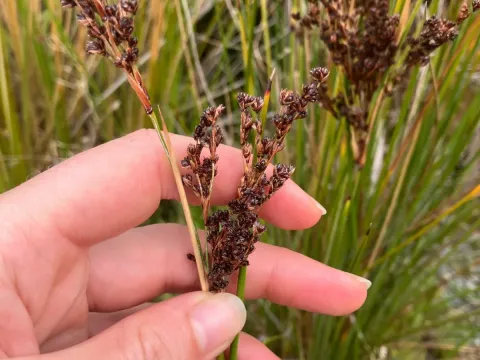
Rush
Juncus L.
Rush (genus Juncus L.) belongs to the family Juncaceae and comprises a diverse group of herbaceous perennials. These plants are uniquely adapted to wetlands, peatlands, and riparian zones, thriving in environments where excessive moisture would typically inhibit the growth of standard agricultural crops.
What the section contains


Rush
To cultivate rush successfully, soil conditions must be consistently moist or saturated throughout the growing season. The plant prefers acidic, nutrient-rich soils that have high water retention capacity, such as peat or heavy clay, making it an ideal candidate for reclaiming wetland areas.
Botanically, rushes are distinguished by their cylindrical, leafless or reduced-leaf stems, which contain a pithy center. This structure provides the necessary structural integrity for the plant to withstand wind and water pressure in open marshy environments, while maintaining efficient photosynthetic activity through the stems.
Economically, rushes serve several purposes: they are widely used in artisanal handicrafts for weaving mats, baskets, and chair seats. Furthermore, they play a crucial role in ecological restoration, preventing soil erosion along banks and providing essential habitat for local aquatic fauna.
Regarding management, rush is relatively low-maintenance once established. It is highly competitive in its native wetland habitat, often forming dense colonies that effectively suppress weed species. Its cultivation requires minimal intervention, provided the hydrological regime remains stable.
Rushes are notably robust and show significant resistance to most common agricultural pathogens. However, in poorly managed stands where water circulation is insufficient, the development of rust fungi may occur, manifesting as small brownish lesions along the stems, which can affect the fiber quality.
Insects rarely cause significant damage to Juncus stands under normal ecological conditions. The primary threat to the health of the crop is anthropogenic hydrological alteration, such as excessive drainage, which leads to immediate stress and allows invasive terrestrial plants to outcompete the rush population.