
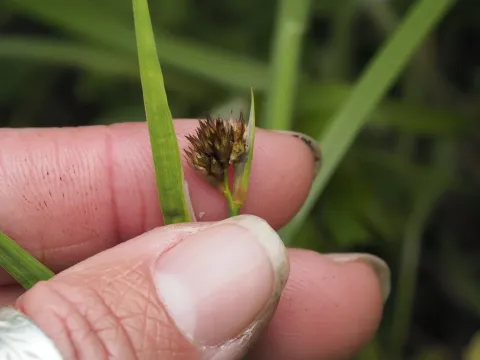
Rocky Mountain rush
Juncus ensifolius
The Rocky Mountain rush (Juncus ensifolius) is a perennial herbaceous plant belonging to the Juncaceae family. It is native to the western parts of North America, where it thrives in wet meadows, marshes, and along the banks of alpine streams and ponds.
What the section contains
Rocky Mountain rush
Botanically, this species is defined by its distinctive, flattened, sword-shaped leaves that arise from the base. It produces clusters of dark brown, globe-shaped flower heads that bloom from summer through early autumn, providing significant aesthetic appeal in wetland settings.
The culture requires consistently moist to saturated soils to thrive. It is highly tolerant of various light conditions, performing best in full sun but capable of tolerating partial shade, making it a versatile choice for rain gardens or pond edges.
Regarding soil preferences, it excels in acidic to neutral soils with a high organic content. While it can tolerate heavy clay soils, it demands sufficient moisture and performs poorly in dry or drought-prone environments, which can lead to quick wilting.
In terms of cultivation, it is often propagated by division of the rhizomes. Once established, the plant creates dense, tufted clumps that effectively stabilize the soil and prevent erosion in moist areas, serving both decorative and environmental functions.
Juncus ensifolius is remarkably resistant to many of the common pathogens that affect typical garden plants. It is rarely susceptible to the rusts or fungal leaf spots that plague other grass-like species in damp conditions, owing to its natural evolution in wetland habitats.
Insects and other agricultural pests generally find the tough, silica-rich foliage unpalatable. Consequently, there is little need for pesticide applications, which makes the Rocky Mountain rush an excellent candidate for sustainable, low-maintenance ecological landscape projects.
Maintenance threats mainly involve improper moisture management. If the soil is allowed to dry out completely, the plant's growth vigor decreases significantly, making it susceptible to environmental stress and opportunistic secondary pathogens.
Overcrowding can lead to the accumulation of old, decaying organic matter at the base of the clumps. It is recommended to prune away dead foliage at the end of the season to ensure healthy spring regrowth and to maintain the plant's attractive appearance.
Invasive weed competition is generally not a threat once the rush has become established. Its aggressive, rhizomatous growth habit allows it to outcompete most surrounding vegetation, establishing a self-sustaining patch that requires minimal human intervention.