
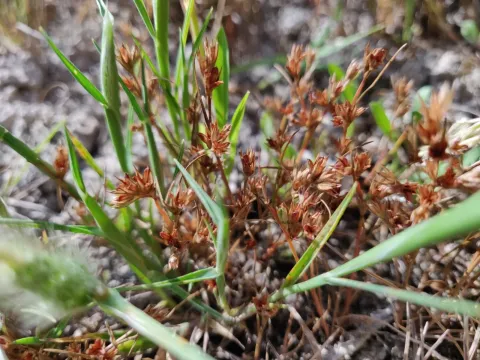
Toad rush
Juncus hybridus
Toad rush (lat. Juncus bufonius) is an annual herbaceous plant belonging to the Juncaceae family. Unlike many of its perennial relatives in the Juncus genus, this species completes its entire life cycle within a single growing season.
What the section contains
Toad rush
The plant has a cosmopolitan distribution, meaning it is found in almost all regions of the world, from temperate zones to subtropical areas, provided that moisture levels are sufficient for its development.
Botanically, it is characterized by thin, branched stems, often forming dense tufts. The leaves are slender and thread-like, mostly basal, and the inflorescences are distinct, often with pale greenish or brownish flowers located at the stem tips.
Regarding climate and soil, toad rush thrives in damp, muddy, and even waterlogged soils. It is frequently found near ponds, in roadside ditches, and on irrigated lands where the water table is persistently high.
In terms of agricultural significance, it is often viewed as a problematic weed in specific environments like rice paddies or poorly drained fields, where it competes aggressively with crops for water and mineral nutrients.
The main threat posed by toad rush to agriculture is its ability to colonize wet disturbed soils, where it can rapidly form dense stands that suppress the early growth of more sensitive crop species.
Disease incidence in toad rush is typically low in terms of crop impact, but it can occasionally harbor fungal pathogens that are capable of jumping to valuable grain or vegetable crops in humid conditions.
Pests that affect the plant are generally limited to moisture-loving insects and small larvae that feed on the soft, succulent stem tissues typical of this species.
Effective management strategies center on soil drainage improvements, which effectively limit the habitat suitability for toad rush, as it cannot compete well in drier, well-tilled soil profiles.
In scenarios where drainage is not feasible, selective chemical weeding remains the primary method for controlling population density in affected fields to ensure optimal crop yields.