
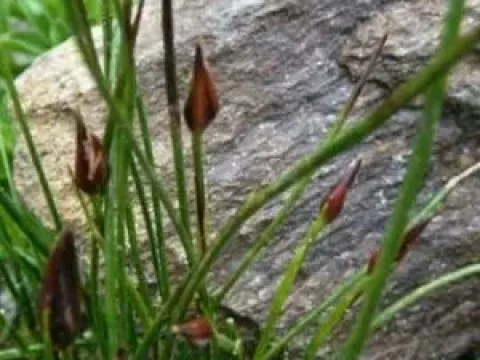
Three-flowered rush
Juncus triglumis
The Three-flowered rush (Juncus triglumis) is a perennial herbaceous plant belonging to the Juncaceae family. It is a highly specialized species adapted to harsh alpine and arctic environments where soil nutrient availability is typically low.
What the section contains
Three-flowered rush
Botanically, the plant is characterized by its compact, tufted growth habit, with slender stems reaching 5 to 15 centimeters. The leaves are grass-like and narrow, an essential adaptation to survive in regions with intense wind and freezing temperatures.
Its natural range encompasses circumpolar arctic regions and alpine zones throughout the Northern Hemisphere, including the Alps, the Caucasus, and the mountainous areas of North America. It is a signature species of cold-climate wetlands.
The plant strictly requires consistently moist, poorly drained soils. It is typically found in flushes, seepage areas, and along the banks of cold streams, where it thrives in conditions that would be unsuitable for more common plant species.
In terms of ecological management, the Three-flowered rush is used primarily for the stabilization of fragile substrates in tundra restoration projects. It functions as a key indicator species for the ecological health of high-altitude wetland ecosystems.
The primary threat to the Three-flowered rush is climate change, specifically the alteration of local hydrology. As high-altitude seeps dry up due to warming trends, the plant loses its critical niche and faces immediate loss of habitat.
Disease pressure on this species is minimal in its natural habitat due to the harsh environmental conditions. Pathogens such as fungi rarely affect populations unless the local ecosystem experiences significant, unnatural fluctuations in water temperature.
Invasive species and competitive grasses represent a secondary threat. As alpine regions warm, more aggressive vegetation moves into the territory of the Three-flowered rush, rapidly outcompeting it for space and light resources.
Pest damage is generally insignificant, although certain specialized herbivorous insects may occasionally cause minor leaf tissue loss. Given the slow growth rate of the species, even minor damage can have a long-term impact on plant vigor.
Human activities, including infrastructure development in alpine areas and intensive soil compaction, represent high-risk factors. The species lacks the physiological plasticity required to recover quickly from mechanical damage to its root system.