
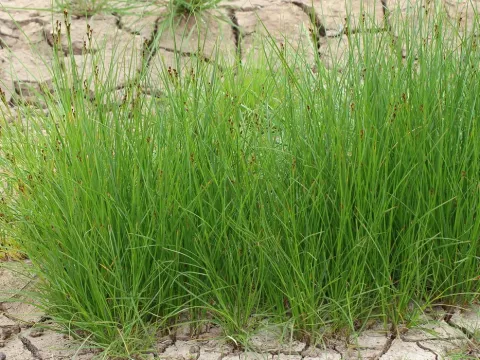
Saltmarsh rush
Juncus gerardi
Saltmarsh rush (Juncus gerardi) is a perennial herbaceous plant belonging to the Juncaceae family. It is a true halophyte, characterized by its remarkable tolerance to high salinity levels, which allows it to thrive in environments where traditional agricultural crops cannot survive.
What the section contains
Saltmarsh rush
The species has a wide distribution range, occurring naturally in coastal zones across Europe, North Africa, and North America. It is typically found in wet areas, including marshes and saline meadows, that are frequently inundated by seawater, creating an osmotic challenge that most other plants cannot overcome.
Botanically, this crop is a rhizomatous plant with slender, erect stems ranging from 10 to 40 cm in height. The narrow, channeled leaves are primarily arranged in a basal rosette, while the inflorescence consists of a loose panicle with dark brown flowers that stand out during the flowering period.
The plant requires high moisture levels and adequate sunlight for optimal growth. It is highly adapted to the conditions of salt marshes, where its root system forms a dense mat that effectively binds the soil and prevents erosion during tidal movements.
From an agricultural management perspective, this crop requires minimal intervention. It does not need synthetic fertilizers or intensive tillage, as it is evolved to withstand the harsh conditions of saline substrates, which reduces the operational costs of maintaining these coastal lands.
The primary agricultural use of saltmarsh rush is for livestock grazing on natural pasturelands. The plant provides acceptable nutritional value for cattle and sheep when harvested or grazed during its early growth phases, before the stems become overly lignified and tough.
Hay production is rarely practiced due to the relatively low biomass yield compared to conventional forage grasses. However, in regions where land productivity is limited by high salt content, it serves as a critical source of roughage for grazing animals.
When utilizing saltmarsh rush for pastures, controlled grazing management is essential. Excessive trampling can damage the rhizomatous network, which is vital for maintaining the structural integrity of the soil in tidal areas.
Beyond forage, the plant is highly valued in ecological engineering. Its ability to create a resilient turf makes it a preferred species for the restoration of degraded salt marshes and the protection of shorelines against coastal erosion.
Increasing interest in sustainable land use has highlighted the potential of saltmarsh rush in phytoremediation projects, where it acts as a stabilizing agent that prevents further soil degradation in sensitive marine and coastal environments.
Saltmarsh rush exhibits significant resistance to many common agricultural diseases that affect traditional grain and forage crops. This is largely due to the saline environment it inhabits, which effectively inhibits the growth of various pathogenic fungi and bacteria.
The most significant threats to the species are related to changes in local hydrological regimes. Land drainage or artificial freshwater influx can lead to soil desalination, causing the saltmarsh rush to lose its competitive advantage and eventually be replaced by non-halophytic vegetation.
There are few specific pests documented for this species. Insect herbivory in natural populations is generally low and does not pose a serious risk to the overall health or productivity of the stands under typical environmental conditions.
Anthropogenic pollution, such as petroleum spills or heavy metal contamination in coastal waters, presents a serious hazard. The plant may bioaccumulate these toxins, rendering the forage unsuitable for livestock and potentially leading to the death of the vegetation.
Climate change, manifesting as rising sea levels, poses a long-term risk. Rapid inundation that exceeds the biological limits of the saltmarsh rush can lead to the submergence and loss of vital coastal habitats, threatening the survival of existing populations.