
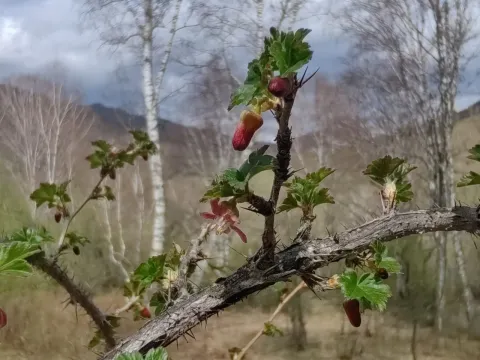
Spiny currant
Ribes aciculare
Spiny currant (Ribes aciculare) is a deciduous shrub belonging to the Grossulariaceae family, known for its distinct morphology. This hardy plant is particularly notable for the sharp, needle-like spines located at the nodes of its branches, which serve as a natural defense mechanism in its native high-altitude habitats.
What the section contains
Spiny currant
The species originates from the mountainous regions of Central Asia and Siberia. It is well-adapted to rocky slopes and river valleys, characterized by thin, nutrient-poor soils and a short growing season. This evolutionary background makes it an exceptionally resilient plant in various environmental conditions.
Botanically, the shrub is compact, typically growing no more than one meter in height. Its leaves are small and often pubescent, an adaptation that allows the plant to reduce transpiration rates and withstand the intense winds typical of high-mountain environments.
When cultivating this species, it is essential to prioritize excellent soil drainage. Ribes aciculare thrives in sandy or rocky soils and is highly sensitive to waterlogging. It requires full sunlight exposure to develop its characteristic structure and maintain its overall health throughout the season.
Maintenance involves minimal intervention. It does not require intensive fertilization, as it is accustomed to poor mountain soils. Instead, regular thinning of the branches and ensuring the plant has enough space to receive air circulation are the most critical aspects of successful management.
The fruit of the spiny currant is small and generally tart, which limits its direct commercial use for the fresh market. However, it holds significant value in professional breeding programs due to its genetic traits, specifically its cold hardiness and resistance to harsh environmental stressors.
Like many species in the genus Ribes, the spiny currant can be susceptible to powdery mildew if grown in humid, poorly ventilated conditions. Ensuring proper spacing between plants is the most effective cultural practice to mitigate the risk of fungal infections.
Insects such as aphids and spider mites are common pests that may infest the young growth. Integrated pest management, focusing on early detection and the use of insecticidal soaps, is usually sufficient to maintain the vigor of the plant without the need for heavy chemical applications.