
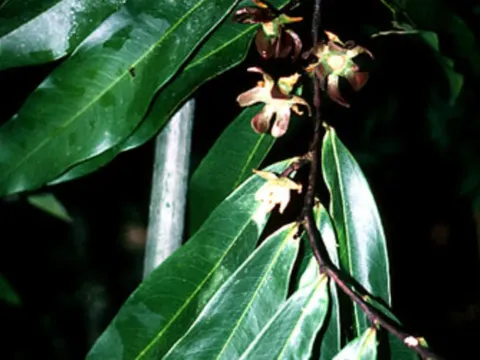
Guatteria amplexifolia
Guatteria amplexifolia
Guatteria amplexifolia belongs to the Annonaceae family, an important group of tropical flowering trees and shrubs. Originating from the humid regions of Central and South America, it naturally thrives in rich, forested environments.
What the section contains
Guatteria amplexifolia
The climate requirements for this plant are stringent, demanding high temperatures throughout the year and high levels of atmospheric humidity. It is strictly a tropical species and will fail to thrive in regions with cold winters or significant thermal fluctuations.
Soil requirements focus on deep, well-draining substrates that are rich in organic matter. While the plant appreciates consistent moisture, it is sensitive to waterlogging, which necessitates careful soil preparation and drainage management.
Cultural management involves providing adequate shade for seedlings, as direct intense sunlight can damage the leaves. As the plant matures, it requires space to develop its canopy and regular monitoring of soil fertility levels to support its growth cycle.
Botanically, Guatteria amplexifolia is distinguished by its unique leaf arrangement where the leaf bases embrace the stem. These morphological features are key for identification and suggest its evolutionary adaptation to the tropical canopy layer.
Agricultural use of Guatteria amplexifolia is currently limited to small-scale or local utilization rather than large-scale industrial farming. The wood is occasionally used for traditional construction and tool crafting by local communities.
There is anecdotal evidence of the consumption of fruits by indigenous populations, though yield statistics for industrial harvest do not exist. Further research into the phytochemical properties of this species could lead to new uses in herbal medicine.
Cultivation is primarily restricted by the lack of optimized commercial propagation protocols. Growers often rely on direct sowing of seeds, which must be planted shortly after harvest due to their short viability period.
The yield of usable plant material is influenced heavily by the micro-climate in which the tree is planted. In optimal tropical environments, the tree shows steady growth, but it does not produce high-volume yields in a traditional agricultural sense.
Future development of this crop may depend on selective breeding aimed at improving fruit yield or bark quality for secondary industry uses. Until then, its status remains that of a specialty or niche tropical botanical specimen.