
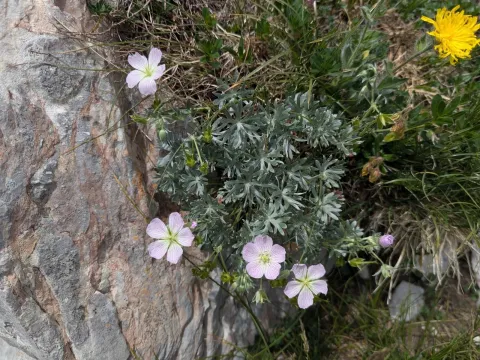
Silver crane's-bill
Geranium argenteum
Silver crane's-bill (Geranium argenteum) is a delicate perennial plant belonging to the Geraniaceae family. This alpine species is native to the high-mountain regions of the Alps, specifically across Italy and France.
What the section contains
Silver crane's-bill
The culture is characterized by its compact size, typically reaching a height of only 10–15 cm. A major botanical feature is the silver-grey pubescence on the leaves, which provides an ornamental appearance even outside the flowering season.
The plant has high requirements for soil drainage. In its natural habitat, it grows on rocky screes, so in cultivation, it is crucial to provide a poor, stony substrate with a neutral to slightly alkaline reaction.
For successful growth, open sunny locations are necessary. Silver crane's-bill does not tolerate standing water in the root zone, which can quickly lead to rot of the root crown and death of the plant.
The culture possesses high winter hardiness characteristic of mountain plants; however, it suffers from excessive humidity in the air and soil during the autumn-winter period, requiring protection from damping off.
The main threat to this species is posed by fungal diseases caused by excessive moisture. These include various root rots and leaf spots that occur when the agrotechnical regime is violated.
Pests rarely cause serious damage to this crop; however, when grown in greenhouse conditions or with improper care, it may be susceptible to spider mites or aphids that feed on the sap of young shoots.
To prevent diseases, it is essential to maintain proper spacing during planting to ensure constant air circulation. Mulching the soil surface with gravel is recommended to prevent contact between leaves and moist soil.
Nematode infestation is a specific problem for some representatives of the genus, so when purchasing planting material, one should pay attention to the condition of the root system.
In case of signs of rot, it is necessary to immediately remove the affected parts of the plant and treat the soil with systemic fungicides to prevent the further spread of pathogens.