
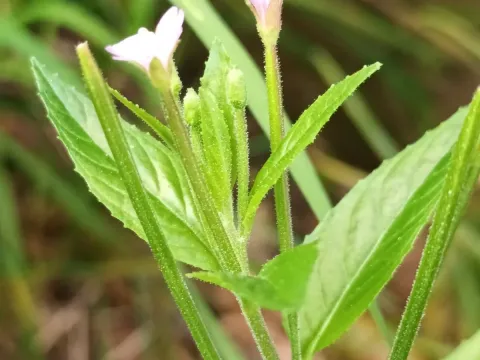
Glandular willowherb
Epilobium glandulosum
Glandular willowherb (Epilobium glandulosum) is a perennial herbaceous plant belonging to the Onagraceae family. It is distinct for the presence of glandular hairs on its stems and inflorescences, which give it a sticky texture and a unique appearance among other willowherb species.
What the section contains
Glandular willowherb
The plant typically grows in moist to wet habitats, including wetlands, streambanks, and marshy meadows. It thrives in temperate regions where moisture levels remain consistently high throughout the growing season, showing high adaptation to hydromorphic soils.
Botanically, it features erect stems reaching up to 90 cm in height, lanceolate leaves, and small, often pale pink to white flowers. Its root system is capable of vigorous vegetative spread, which allows it to form dense colonies in favourable environmental conditions.
In agriculture, Epilobium glandulosum is primarily recognized as a weed. It competes with crops in poorly drained fields and irrigation channels, potentially reducing yield by monopolizing water and soil nutrients in the saturated zones of the agricultural landscape.
Soil preferences lean towards nutrient-rich, moist substrates, often with slightly acidic to neutral pH levels. It is rarely found in dry or arid environments, which makes proper field drainage an effective cultural control strategy to manage its presence in farming systems.
The plant can be susceptible to various rust fungi and leaf-spotting pathogens that affect the Onagraceae family. These natural enemies can occasionally limit the spread of the plant within a population, although they rarely provide total control in agricultural settings.
Mechanical control, such as consistent mowing prior to flowering, is effective at reducing the population density. By preventing the plant from producing seeds, which are dispersed by wind, farmers can prevent further colonization of adjacent clean fields.
Chemical management involves the use of systemic herbicides, particularly those targeting broadleaf weeds. Optimal control is achieved when treatments are applied during the vegetative stage, before the plant allocates significant energy to reproductive development.
Cultivation practices that include deep plowing and adequate drainage significantly disrupt the root systems and limit regrowth. Removing the moisture-rich micro-environment that the plant requires is key to preventing re-infestation.
Monitoring the edges of fields and drainage infrastructure is essential, as these areas often serve as reservoirs for seeds. Integrated weed management programs that prioritize habitat modification remain the most sustainable approach to handling this species.