
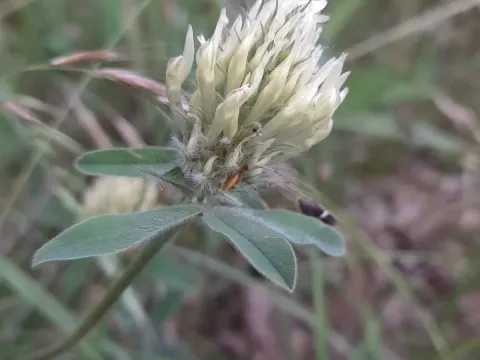
Pale-yellow clover
Trifolium ochroleucon
Pale-yellow clover (Trifolium ochroleucon) is a perennial herbaceous plant belonging to the Fabaceae family. Sowing of this crop is usually carried out in early spring or late summer, when the soil has sufficient moisture for seed germination.
What the section contains
Pale-yellow clover
For successful planting, it is recommended to scarify the seeds beforehand, as they possess a hard seed coat. The optimal planting depth is between 1 and 2 centimeters in a well-prepared, weed-free soil.
When establishing pastures or hayfields, Pale-yellow clover is often sown in mixtures with grasses. This combination creates a more stable and nutritious ground cover that effectively resists soil erosion.
An important factor during sowing is the planting density, which should provide enough space for the development of a robust root system. The seeding rate is calculated based on the purity and germination capacity of the specific seed batch.
After sowing, it is recommended to roll the field to ensure better contact between seeds and soil particles. Seedlings emerge gradually, depending on the temperature and the timeliness of precipitation in the post-sowing period.
The plant demonstrates high ecological plasticity, but it prefers open, sunny areas with moderate moisture. The crop exhibits excellent resistance to dry periods due to its well-developed taproot system.
The most favorable soils for its growth are carbonate, loamy, or sandy soils with a neutral or slightly alkaline pH. Pale-yellow clover does not tolerate prolonged waterlogging on the field.
The optimal climatic zone for the full development of the species includes regions with a temperate continental climate. The plant is well adapted to temperature fluctuations and is characterized by sufficient winter hardiness.
In its natural habitat, the species grows on dry meadows, steppes, and forest edges across Europe and Western Asia. The crop has very low requirements for additional nitrogen fertilizers, as it successfully forms a symbiosis with nodule bacteria.
Agrotechnical requirements include periodic cultivation between rows during the first year of life to prevent weed infestation. In subsequent years, the clover forms a dense turf capable of suppressing competing vegetation on its own.
The yield of Pale-yellow clover largely depends on growing conditions and the composition of the stand. As a forage crop, it is valued for its high protein and mineral content, which is essential for livestock nutrition.
The average yield of green mass varies depending on the number of cuts per growing season. Under conditions of sufficient moisture, the plant provides a high-quality regrowth after the primary mowing.
The productivity of the crop is maintained due to its high level of shoot regeneration following mechanical stress. The plant is capable of effective recovery, making it promising for long-term use in pastures.
The agricultural use of Pale-yellow clover includes the harvesting of hay, haylage, or its use as green fodder. It is important to choose the correct time for mowing to obtain forage with maximum nutritional value.
Beyond forage purposes, the crop is used as a honey plant, attracting a large number of pollinators. Its use in apiculture significantly increases the overall economic efficiency of cultivating this species.
Pale-yellow clover is relatively resistant to the main diseases characteristic of legumes. However, under high humidity, infection by fungal diseases such as rust or leaf spot is possible.
Among pests, the greatest danger is posed by clover root curculios, which damage the root system and leaves during the early stages of development. Also, significant damage can be caused by various species of aphids and the clover seed chalcid.
Disease prevention consists of adhering to crop rotation and avoiding excessive crop density. A healthy stand with good aeration is significantly less prone to attacks by harmful organisms.
In the event of mass pest outbreaks, the use of biological plant protection agents that are safe for pollinators is acceptable. The use of potent pesticides is undesirable due to the risk of lowering forage quality.
Monitoring the state of the crop should be carried out regularly, especially during the flowering and pod formation periods. Timely detection of threats allows for stopping the spread of infections without large-scale chemical treatments.
Harvesting for hay is conducted during the stage of mass flowering, when the nutrient content in the green mass reaches its peak. Mowing is carried out mechanically, followed by drying in the swaths.
It is important to avoid over-drying to preserve the leaves, which contain the main store of protein. The tedding process must be gentle to prevent the shattering of valuable plant parts during transport.
For seed production, harvesting is performed when the heads turn brown and become hard to the touch. The timing of this operation is critical, as delays can lead to large losses due to natural seed shattering.
Seed plots require delicate handling: after harvesting, seeds undergo cleaning and drying to standard moisture content. Well-cleaned seed material retains high germination energy for several years.
After harvest, fields should be cleared of plant residues to prevent the accumulation of pathogens. Proper organization of the harvest ensures both economic efficiency and the longevity of the crop in the pasture.