
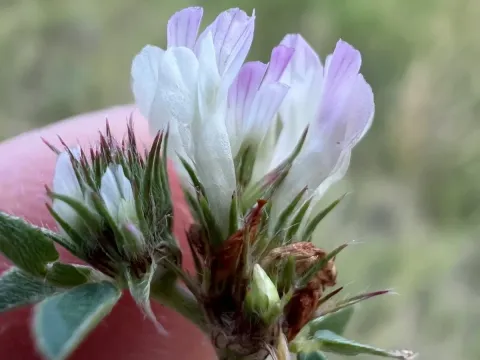
Dalmatian clover
Trifolium dalmaticum
Dalmatian clover (Trifolium dalmaticum) is an annual legume species adapted to the Mediterranean climate. Planting is typically scheduled for autumn to allow for winter establishment or early spring when soil temperatures reach stable levels.
What the section contains
Dalmatian clover
For successful germination, seeds should be sown at a shallow depth, ideally between 0.5 and 1.5 cm. Precision seed drills are recommended to ensure even distribution and uniform plant emergence across the field.
Seedbed preparation should involve fine-tilth cultivation followed by light rolling to maximize contact between the seed and the soil moisture. This is especially important in dry regions to ensure rapid water uptake by the developing embryo.
The seeding rate varies depending on the intended use—whether for pasture improvement, soil cover, or specialized seed production. Proper plant density is essential for minimizing competition and maximizing individual plant productivity.
In mixed cropping systems, Dalmatian clover should be sown at a reduced rate to avoid over-competition with grasses. Monitoring soil temperature and moisture after sowing is vital for assessing establishment success.
Dalmatian clover thrives in well-drained, light-textured soils such as loams or sandy loams. It has a high tolerance for alkaline soil conditions and can perform well where other legumes struggle.
The species requires full sun exposure to maintain high photosynthetic activity. It is sensitive to competition from aggressive weeds, necessitating proactive management during the establishment phase.
While exhibiting significant drought tolerance, optimal biomass production is achieved when soil moisture is consistent throughout the vegetative growth period. It is well-suited for regions with seasonal rainfall patterns.
Nutrient management focuses on phosphorus and potassium, as the plant efficiently fixes nitrogen through symbiotic relationships with specialized bacteria. Excessive nitrogen fertilization is generally not recommended.
The climate requirements align with Mediterranean zones characterized by mild winters and warm springs. The crop is not highly tolerant of severe, prolonged frosts and is best suited for climates with temperate or subtropical influences.
The primary threats to Dalmatian clover include fungal diseases such as root rot and leaf spot. These pathogens are most prevalent in fields with poor drainage or during extended periods of humid weather.
Pests, particularly clover weevils and aphids, can cause significant damage to young plants and seed heads. Integrated pest management (IPM) strategies, including biological controls, should be the first line of defense.
Virus transmission by insect vectors poses a risk to field uniformity. Maintaining a clean field environment by eliminating reservoir weeds is a critical step in reducing infection pressure.
In cases of high infestation, targeted insecticide applications may be necessary. However, growers should always prioritize the protection of beneficial insects, especially pollinators, during the flowering stage.
Effective management includes regular field scouting to identify issues early. Proactive measures such as balanced fertilization and proper crop rotation significantly improve the plant's natural resilience to biotic stressors.
Harvesting for forage should be timed to coincide with the early flowering stage to achieve the best balance between biomass quantity and nutritional quality (crude protein content).
When producing seed, harvest should occur when the majority of the pods have turned color and matured. Mechanical harvesting requires careful adjustment of combine settings to prevent seed shattering losses.
Drying of the harvested material must be efficient to prevent spoilage and mycotoxin development. Proper storage conditions, specifically low humidity and cool temperatures, are essential for maintaining seed viability.
After the primary harvest, fields may be grazed lightly by livestock, provided the soil is dry enough to prevent compaction and the plants have had sufficient time to recover.
Post-harvest management should include soil testing and nutrient replenishment to prepare the site for the next cycle or subsequent crop in the rotation.