
Ormosia
Ormosia
Ormosia is a genus of large trees and shrubs belonging to the Fabaceae (legume) family. There are approximately 100 species in the genus, found primarily in the tropical regions of the Americas, Asia, and Australia.
What the section contains
 Ormosia arborea
Ormosia arborea
Ormosia arborea
 Ormosia bancana
Ormosia bancana
Ormosia bancana
 Ormosia calavensis
Ormosia calavensis
Ormosia calavensis
 Ormosia coarctata
Ormosia coarctata
Ormosia coarctata
 Ormosia coccinea
Ormosia coccinea
Ormosia coccinea
 Ormosia coutinhoi
Ormosia glauca
Ormosia glauca
Ormosia coutinhoi
Ormosia coutinhoi
Ormosia glauca
Ormosia glauca
 Ormosia hosiei
Ormosia hosiei
Ormosia hosiei
 Ormosia macrodisca
Ormosia macrodisca
Ormosia macrodisca
 Ormosia monosperma
Ormosia nobilis
Ormosia nobilis
Ormosia monosperma
Ormosia monosperma
Ormosia nobilis
Ormosia nobilis
 Ormosia ormondii
Ormosia ormondii
Ormosia ormondii
 Ormosia paraensis
Ormosia paraensis
Ormosia paraensis
 Ormosia pinnata
Ormosia pinnata
Ormosia pinnata
 Ormosia sumatrana
Ormosia sumatrana
Ormosia sumatrana
Ormosia
The plant prefers humid tropical and subtropical climatic conditions. The most favorable regions for its growth are those with high average annual temperatures and stable humidity levels, where sudden frosts are excluded.
Ormosia has specific soil requirements: the tree needs deep, fertile, well-drained loams or sandy soils with a neutral or slightly acidic pH level.
During the growth process, young specimens require protection from direct sunlight; however, mature trees are sun-loving and need good light exposure to develop a full canopy and bloom.
Agricultural management includes the regular application of organic fertilizers during the active growing season and careful monitoring of the root system, which is sensitive to waterlogging.
The economic use of Ormosia is primarily linked to the harvesting of valuable timber, often known as "redwood" or "coral tree." It is prized for its strength, beautiful grain, and resistance to decay.
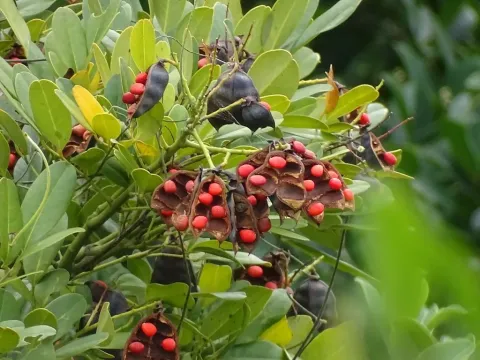
The seeds of Ormosia, characterized by their striking bright red or red-and-black color, are used in arts and crafts. They are frequently utilized for making beads, necklaces, and other ornamental jewelry in regions of natural occurrence.
In agriculture and forestry, Ormosia can be planted as part of reforestation efforts to restore soil fertility, as it is a leguminous plant capable of nitrogen fixation.
Timber yield depends directly on planting density and maintenance conditions. In industrial plantations, the cultivation cycle to reach commercial maturity can take several decades, requiring long-term planning.
The biological productivity of the crop also includes the production of seeds, which, when properly dried and processed, can serve as decorative raw material for export markets.
The primary threats to Ormosia include fungal infections that affect the root system during periods of excessive moisture. Additionally, the tree can suffer from various leaf spot diseases caused by pathogenic fungi.
Among pests, the most dangerous are the larvae of wood-boring beetles and bark beetles, which damage the trunk, lowering the quality of the wood and the overall health of the tree. Preventive insecticide treatments are used to manage these pests.
Soil nematodes can also pose a serious risk to young saplings by inhibiting root development. Crop rotation or soil substrate disinfection before planting in nurseries is highly recommended.
In dense plantation conditions, there is an increased risk of spreading viral diseases transmitted by insect pests. Important control measures include timely sanitary pruning and the removal of affected plant parts.
Climate factors, such as prolonged drought, can weaken the tree's immune system, making it more susceptible to secondary infections and infestations by herbivorous insects.