
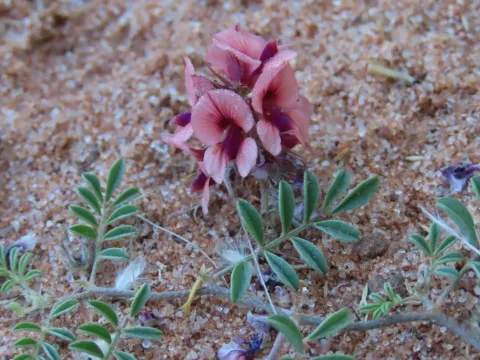
Indigofera alternans
Indigofera alternans
Indigofera alternans is a perennial leguminous plant well-adapted to the arid environments of Southern Africa. As a forage crop, it provides a vital source of protein for livestock in regions where other vegetation struggles to survive during dry seasons.
What the section contains
Indigofera alternans
The sowing season is determined by the arrival of the first significant rains. Successful establishment depends on ensuring seeds are sown into moist soil, allowing roots to penetrate deeply before the intense heat of the season sets in.
Given the hard seed coat typical of many Indigofera species, mechanical or chemical scarification is often employed prior to planting to improve germination rates. This step is essential for achieving a uniform stand across large tracts of land.
Seed depth should be carefully controlled, generally placed at 1-2 cm. Excessive depth can prevent emergence, as the energy stored in the small seed is insufficient to support a long hypocotyl in harsh, dry soils.
Row planting is the preferred method for agricultural cultivation. This allows for mechanical weed control during the early stages of growth and ensures that each plant has sufficient access to nutrients and water.
This species is highly drought-tolerant, exhibiting a resilient growth pattern in sandy and loamy-sand soils. It thrives in environments where rainfall is sparse and sporadic, making it an excellent candidate for semi-arid land rehabilitation.
High solar radiation is required for optimal development. Indigofera alternans performs best in full sunlight; growth is significantly restricted in shaded conditions, which also reduces the plant's nutritional density.
The plant is highly temperature-resilient, functioning effectively within a broad range of heat levels. It is well-suited to regions with extreme diurnal temperature fluctuations, common in desert-adjacent agricultural zones.
Soil requirements are relatively modest. While it prefers neutral to slightly alkaline pH levels, its primary asset is its ability to establish symbiotic relationships with soil bacteria, which fixes atmospheric nitrogen.
Proper drainage is critical. Although it survives drought, Indigofera alternans is sensitive to waterlogging. Sites should be selected where the soil structure allows for quick water percolation to avoid root rot.
Forage production is directly proportional to seasonal rainfall. During wet periods, the biomass accumulation is substantial, providing enough material to be grazed or harvested as high-quality dry forage for livestock.
The nutritional profile of this legume remains high throughout its growth cycle. It is particularly valued for the high protein content in its leaves, which makes it a preferred grazing choice for herbivores in its native habitat.
Management through rotational grazing is highly recommended. By allowing the plants to recover after periods of intensive feeding, farmers can maintain the vigor of the stand and ensure high productivity over many years.
Seed production is a secondary but important economic use of the crop. Harvesting is usually performed as soon as the pods dry on the plant, before natural dehiscence occurs, which would otherwise result in seed loss on the ground.
Yields can be maximized by ensuring the plant population is not overly dense, which prevents competition for moisture. Providing adequate space allows the root system to expand and utilize more water resources.
The most significant threat to seed stock is infestation by bruchid beetles. These insects bore into the developing pods and consume the seeds, often destroying a large percentage of the harvest if not managed properly.
Defoliating insects can occasionally reach pest status, particularly during the early vegetative phase. These infestations weaken the plant, reducing its ability to recover after grazing or cutting for hay.
Root-knot nematodes can become a problem in intensively farmed areas. This is primarily an issue when the crop is grown continuously on the same land without a proper rotation schedule, leading to soil pathogen buildup.
Fungal pathogens such as powdery mildew can appear during seasons with abnormally high humidity. While usually not fatal to the plant, they reduce the palatability and nutritional value of the foliage for livestock.
Weed competition is the primary limiting factor for successful establishment. In the first few weeks, the slow growth of the seedlings necessitates careful monitoring and weeding to prevent the crop from being choked by fast-growing grasses.