
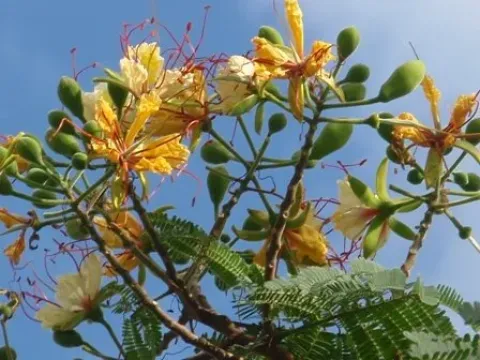
Delonix elata
Delonix elata
Propagation of Delonix elata is primarily achieved through seeds. The hard seed coat requires scarification, such as mechanical abrasion or short-term hot water treatment, to overcome dormancy and ensure uniform germination.
What the section contains
Delonix elata
Sowing should take place at the onset of the rainy season or in a controlled nursery environment where temperatures remain between 22°C and 30°C. Using a sandy, well-draining potting medium is essential for initial root development.
Seedlings need protection from direct, intense midday sun for the first few weeks. Once they reach a height of approximately 30-40 cm, they can be gradually acclimated to full sunlight before transplanting to the field.
Spacing is critical for long-term growth. In agroforestry plantations, trees should be spaced at least 6 to 8 meters apart to prevent competition for light and water in mature stages.
Proper irrigation during the establishment phase is vital; however, once the taproot reaches deeper soil horizons, the plant becomes remarkably self-sufficient in water uptake.
Delonix elata is a deciduous tree belonging to the Fabaceae family, native to arid and semi-arid regions of East Africa, Arabia, and India. It is highly valued for its extreme drought tolerance and ability to thrive in challenging climates.
The tree thrives in full sun and is best suited for well-drained, porous soils. It is particularly effective in stabilizing sandy soils and preventing erosion due to its deep and resilient root structure.
It performs exceptionally well in areas with low annual precipitation. While it adapts to a variety of soil types, it absolutely requires excellent soil drainage to prevent root rot, which is its primary vulnerability in waterlogged conditions.
Temperature-wise, it is strictly a tropical to subtropical species. It does not tolerate frost, and even minor temperature drops below 5°C can cause significant stress or dieback of tender branches.
Being a leguminous plant, it contributes to soil fertility by fixing atmospheric nitrogen, making it an excellent candidate for intercropping and regenerative agriculture practices in semi-arid zones.
The primary agricultural utility of Delonix elata is the production of nutritious forage. The leaves and tender twigs are highly palatable and serve as a critical protein source for goats, camels, and cattle during the dry season.
Harvesting is typically done by pollarding or systematic lopping of the branches. This practice provides immediate fodder while stimulating the growth of new, protein-rich shoots for the following cycle.
The wood of this species is utilized for small-scale rural construction and the manufacture of agricultural tools. Its density and moderate durability make it a preferred local material for fencing and handles.
In certain regions, parts of the tree are also collected for traditional medicinal purposes, highlighting its multifunctional role in community-based agricultural economies.
Sustainable harvesting techniques that balance fodder yield with the tree's health are essential for maintaining long-term productivity in plantation settings.