
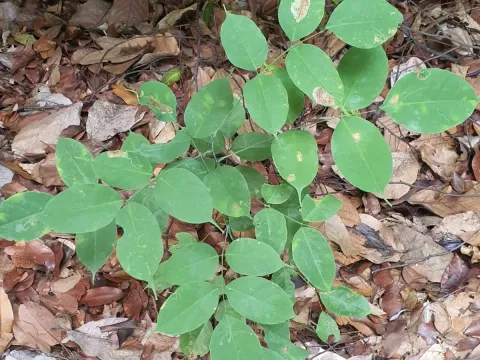
Derris amoena
Derris amoena
Propagation in natural conditions usually occurs by seeds at the beginning of the rainy season, which ensures a high germination rate. For artificial cultivation, stem cuttings in high-humidity greenhouse conditions are preferred.
What the section contains
Derris amoena
Seed sowing requires pre-treatment or soaking in warm water to overcome the hard seed coat characteristic of many legumes. The optimal soil temperature for germination is between 25 and 28 degrees Celsius.
During vegetative propagation, stems are planted in loose, organic-rich substrates with shading provided for the first few weeks. Maintaining stable moisture without waterlogging is critical for root development.
Planting dates depend on the local climate, but the culture requires a long growing season free from temperature fluctuations. Vigorous growth begins once stable warm weather is established.
Proper site selection is essential for biomass accumulation, so planting should be done in well-lit areas sheltered from strong winds to protect the developing vines.
Derris amoena is a member of the Fabaceae family, typically appearing as a perennial vine in tropical rainforest environments. It prefers loose, well-drained soils with a neutral or slightly acidic pH.
The culture has specific light requirements; while young plants need partial shade to prevent leaf scorch, mature specimens can tolerate direct sunlight provided there is sufficient irrigation.
Successful growth depends on high atmospheric humidity and the absence of sudden temperature shifts. The plant does not tolerate drought and requires consistent watering during dry periods.
Agronomic practices include regular weeding around the root zone and the periodic application of organic fertilizers to stimulate growth. As a climbing plant, it requires sturdy trellising for support.
The plant possesses unique chemical properties that provide natural defense mechanisms against various insect species, making it a subject of significant interest in pharmacognosy and agricultural pest control.
Economic use of the plant typically involves the harvesting of roots and bark, which contain rotenone—a natural compound with strong insecticidal properties. Harvest occurs at least 2-3 years after planting.
To maximize the concentration of active compounds, root harvesting is best conducted during the dry season when the plant is in a state of relative dormancy. Careful extraction is necessary to preserve the plant structure.
After harvesting, roots are cleaned, washed, and dried slowly in the shade to prevent the degradation of chemical constituents. Correct drying ensures the preservation of the raw material's insecticidal activity.
Leaf biomass can be utilized as green manure or mulch after mechanical shredding. Handling the harvest requires safety precautions due to the potential toxicity of certain components to humans and animals.
Storage requires well-ventilated facilities protected from direct ultraviolet light and excessive moisture, as both factors can compromise the integrity of the valuable compounds within the raw material.