
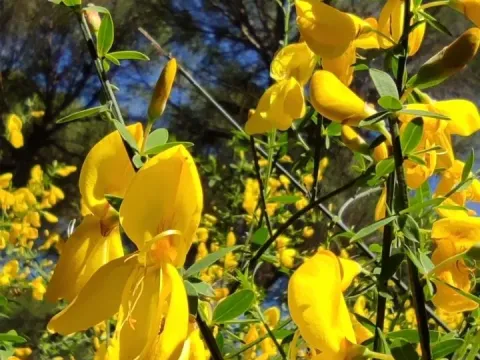
Large-flowered broom
Cytisus grandiflorus
The large-flowered broom (Cytisus grandiflorus) is a prominent member of the Fabaceae (legume) family. This deciduous shrub typically grows as a branched plant with trifoliate leaves, displaying dense clusters of vibrant yellow flowers that make it a highly desirable species for ornamental use.
What the section contains
Large-flowered broom
Native to Southwestern Europe and parts of North Africa, this plant has adapted to Mediterranean and sub-Mediterranean climates. It thrives in full sun exposure, requiring open locations where sunlight can reach all parts of the shrub to maintain its structural integrity and flower density.
When considering soil requirements, the species excels in well-drained, sandy, or gravelly substrates. It is naturally tolerant of low fertility and acidic soils, provided that the drainage is excellent. Waterlogged conditions must be avoided at all costs to prevent root rot in this species.
Agrotechnical practices for the broom involve minimal but precise pruning. It is recommended to prune the plant immediately after the flowering season ends to maintain a compact habit and prevent the wood from becoming overly leggy and brittle over several years of growth.
In terms of agricultural and environmental utility, this plant is used for erosion control and soil stabilization. Due to its nitrogen-fixing properties, it serves as a pioneer species that helps improve soil health, making it ideal for the reclamation of degraded sites or dry coastal regions.
Powdery mildew is the most common fungal disease associated with the large-flowered broom, typically appearing in humid or poorly ventilated environments. Maintaining adequate space between plants and applying systemic fungicides can effectively mitigate the spread of this pathogen.
Insect pests, specifically aphids and certain types of mites, can target tender new shoots during the spring. Early detection is vital for successful control; therefore, gardeners are advised to monitor the plant's growth tips regularly during the active growing season to prevent significant damage.