
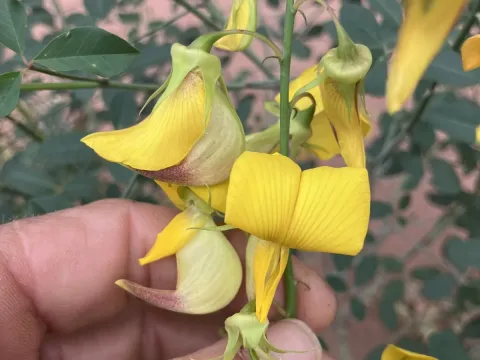
Laburnum-leaved crotalaria
Crotalaria laburnifolia
Crotalaria laburnifolia belongs to the legume family and is a perennial shrubby plant. In agricultural practice, planting is conducted during the season of stable warm temperatures, as the crop is highly sensitive to soil cold.
What the section contains
Laburnum-leaved crotalaria
The optimal sowing period occurs in late spring once the risk of frost has completely passed. Seeds are usually sown in rows, with spacing wide enough to allow for subsequent mechanical field maintenance.
When cultivated as green manure, high seeding density is used to suppress weed growth effectively. Seed treatment before sowing is highly recommended to improve germination energy and uniformity.
In regions with distinct wet seasons, sowing is timed to coincide with the beginning of the rainy season to provide natural irrigation for seedlings. Seeding depth should be between 2 and 3 centimeters depending on the soil structure.
After sowing, the field should be lightly rolled to ensure optimal soil-to-seed contact, which is essential for uniform emergence in varied tropical soil conditions.
This crop is a heat-loving plant originating from tropical regions of Africa and Asia, meaning it thrives primarily in warm climates. The ideal temperature range for its development is between +25 and +30 degrees Celsius.
Crotalaria laburnifolia is relatively undemanding regarding soil type, although it prefers well-drained loams or sandy soils with a neutral or slightly acidic pH. Waterlogging must be avoided to prevent root system decay.
The plant exhibits high drought tolerance due to a strong taproot that penetrates deep into the soil profile. This feature makes it highly resilient in areas that experience periodic water shortages during the growth phase.
Adequate sunlight is a critical requirement for this species; it does not tolerate shading and performs best in open, sunny locations. Insufficient light significantly impairs photosynthesis and overall biomass accumulation.
The plant engages in symbiosis with rhizobia bacteria, allowing for efficient atmospheric nitrogen fixation. This enhances soil fertility and makes it an excellent choice for improving agricultural land sustainability.
Major pests for this crop include Lepidoptera larvae, specifically various cutworm species that can cause significant damage to foliage in young plants. Soil-dwelling larvae can also target roots during the early growth stage.
Common fungal diseases include Fusarium wilt and anthracnose, which typically occur under high-humidity conditions or poor field ventilation. Symptoms often include necrotic spots on leaves and stems.
To mitigate disease and pest risks, it is essential to follow a strict crop rotation plan, avoiding the replanting of legumes on the same plot more than once every 3–4 years.
Integrated pest management, including the use of biological control agents and natural predators, is preferred over chemical interventions. Pesticides should be used only as a last resort if thresholds are exceeded.
Regular field scouting is necessary, particularly during the flowering phase, to detect signs of pest infestation or disease early and apply appropriate management strategies.
For green manure purposes, the crop should be mowed at the mass flowering stage, which is when nitrogen accumulation in the biomass is at its peak. This maximizes the fertilizing effect for the following rotation.
If the goal is seed production, harvesting should be performed once the pods have darkened. It is crucial to monitor the pods closely to prevent natural splitting and seed shattering before collection.
After mowing, the green mass is typically shredded and incorporated into the topsoil via disking to accelerate decomposition and humus formation. This method significantly enhances soil structure over time.
While the plant is a useful legume, it may contain specific alkaloids. Therefore, if the biomass is intended for fodder, it must undergo proper thermal processing and should be limited to specific proportions in the diet.
Harvested seeds must be dried in shaded, well-ventilated areas until moisture content drops to 12–14 percent. Proper storage in dry, cool conditions ensures viability for the next planting season.