
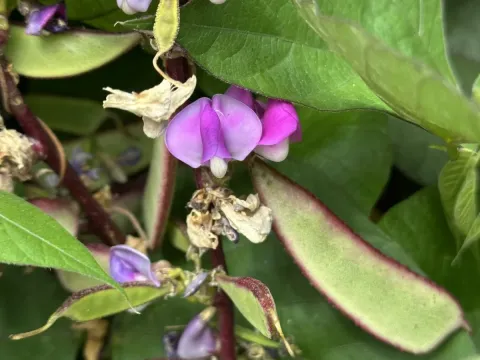
Lablab
Lablab
Lablab is a heat-loving crop, so planting should only take place after the risk of frost has passed. The soil at a depth of 10 centimeters should warm up to at least 15–18 degrees Celsius.
What the section contains

Lablab
The optimal sowing time is late May or early June, depending on the regional climate. Planting too early in cold soil often leads to seed rot, which significantly reduces plant density.
The planting pattern depends on the intended use. For grain or seed production, a wide-row method with spacing up to 70 centimeters is typically utilized.
For green manure or biomass production, denser sowing patterns can be used. Seeds are usually planted at a depth of 4–6 centimeters to ensure good contact with moist soil.
In regions with shorter summers, transplanting 20-day-old seedlings into the soil after the weather stabilizes is a common practice to ensure an earlier harvest.
Lablab belongs to the Fabaceae family and is a climbing herbaceous plant. The crop is highly demanding of sunlight and requires full sun exposure throughout the entire growing season.
It performs best in fertile, loose soils with a neutral or slightly acidic pH. The plant does not tolerate waterlogging, so well-drained fields are essential for success.
While the plant is well-adapted to arid conditions, it requires regular irrigation during flowering and pod development to achieve high biomass yields.
The optimal air temperature for growth is between 20 and 30 degrees Celsius. Below 10 degrees, the growth of Lablab virtually ceases.
The plant has a high nitrogen-fixing capacity due to symbiosis with rhizobia bacteria, making it an excellent precursor crop for many agricultural systems.
Green biomass yields can reach 30–50 tons per hectare under optimal growing conditions and sufficient soil moisture levels.
For grain production, average yields range from 1.5 to 2.5 tons per hectare. Results depend heavily on the variety, planting density, and the availability of trellises for climbing types.
The application of fertilizers, particularly phosphorus and potassium, significantly improves seed output and the protein quality of the harvest.
Under irrigated conditions, Lablab productivity can increase by 1.5 to 2 times compared to rain-fed crops, highlighting the importance of proper water management.
Timely weed control during the early stages of development is a critical factor in preserving the crop's yield potential.
Lablab is susceptible to fungal diseases such as powdery mildew, which often develops during periods of high humidity and poor air circulation within the field.
Root rots pose a serious threat in the first few weeks after emergence, particularly in heavy or waterlogged soil conditions.
Among pests, aphids and spider mites are the most dangerous, as they multiply rapidly in hot, dry weather and can cause significant damage to the foliage.
Bacterial infections can affect stems and pods, causing lesions and premature tissue death, which necessitates the use of high-quality treated seed material.
To prevent the spread of diseases, it is important to practice crop rotation and avoid overcrowded plantings to ensure sufficient airflow between plants.
Harvesting for green biomass is best performed during the peak flowering stage, when nutrient concentrations in the stems and leaves are at their highest.
For grain production, harvesting begins when pods turn brown and seed moisture content drops to 14–16 percent to minimize harvest losses during threshing.
Because Lablab pods are prone to shattering upon full maturity, it is important not to delay harvesting, especially in areas with unpredictable weather patterns.
When harvesting for seeds, desiccation is often used to ensure uniform ripening and to facilitate the mechanical harvesting process.
After collection, seeds must be cleaned and dried to standard moisture levels to ensure stability and quality during warehouse storage.