
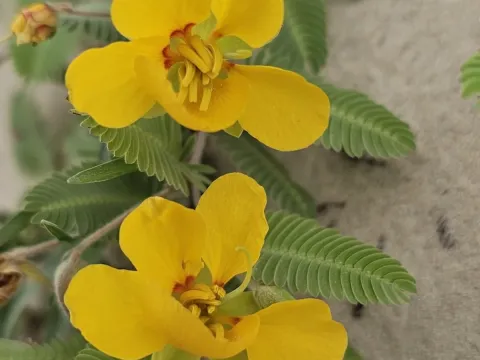
Texas cassia
Cassia texana
Texas cassia (lat. Chamaecrista fasciculata, often referred to as Cassia texana) is an annual herbaceous plant belonging to the Fabaceae family. In its natural habitat, seeds disperse and germinate naturally following the ripening of seed pods in late summer or early autumn.
What the section contains
Texas cassia
In agricultural settings, seeds are sown in early spring once the soil temperature reaches 15–18 degrees Celsius. Providing sufficient soil moisture is crucial for germination, as the seeds possess a hard coat that often requires scarification to improve water absorption before planting.
The planting depth should be 1–2 centimeters, depending on the soil texture. Optimal seeding density depends on the intended use—whether for soil restoration or landscape cover—usually ranging from 20 to 30 plants per square meter.
The plant exhibits high growth vigor, with seedlings typically emerging within 10–14 days under favorable conditions. Early planting allows the crop to maximize the use of spring soil moisture to establish a deep and resilient root system.
To improve field germination rates, pre-sowing seed treatment is frequently employed, ensuring uniform stands and reducing the risk of patchy crop development across the field.
This crop thrives in well-drained sandy, loamy, or silty soils with a neutral to slightly acidic pH level. Texas cassia is highly sensitive to waterlogged conditions; therefore, fields with poor drainage or standing water are entirely unsuitable for its production.
The plant demonstrates exceptional resilience to arid conditions and intense solar radiation, making it an excellent choice for cultivation in southern regions. It efficiently manages limited water resources by developing a robust taproot that reaches deeper soil layers.
The ideal temperature range for successful development is between 20 and 30 degrees Celsius. The crop shows great tolerance to the significant diurnal temperature fluctuations often experienced during the active growing season.
The requirement for supplemental mineral fertilizers is minimal because Texas cassia enters into a symbiotic relationship with nitrogen-fixing root bacteria. This process naturally enriches the soil with nitrogen, significantly improving its long-term agronomic properties.
Light exposure is a critical factor for success; the crop requires full sun throughout the day. In shaded conditions, plants become spindly, and flower production is drastically reduced, affecting the overall ecosystem benefits.
In agricultural production, Texas cassia is rarely grown as a grain or forage crop, serving more frequently as a cover crop, green manure, or soil-improving agent. Biomass production can be substantial under favorable rainfall patterns.
Biological productivity depends heavily on soil fertility and the presence of appropriate nitrogen-fixing bacterial strains. When managed correctly, the plant forms a dense canopy capable of effectively suppressing competing weed species.
Seed yield is naturally high, ensuring self-seeding and regeneration in the field. Harvesting the seed material requires precision, as the pods tend to shatter and release seeds as soon as they reach full maturity.
The economic value of cultivating Texas cassia lies primarily in its contribution to soil structure improvement and organic nitrogen accumulation. This makes it a valuable component of sustainable crop rotations in hot, dry climates.
Beyond its primary agronomic functions, the plant provides a vital service by attracting beneficial pollinators, which can improve the overall yield of surrounding entomophilous crops.
Texas cassia possesses high innate phytosanitary resilience, though it may occasionally be susceptible to fungal infections in high-humidity environments. Root rot remains the primary threat, typically induced by poor drainage or overwatering.
Pests common to legumes, such as weevils or aphids, may cause damage to young shoots or floral buds. Regular monitoring during the flowering stage is essential for the early detection and management of pest infestations.
Leaf spot diseases are also potential pathogens, thriving under conditions of high humidity and poor air circulation within the stand. Effective mitigation strategies include maintaining recommended seeding rates and selecting sites with good air flow.
Nematodes may impact the root system in sandy soils, leading to stunted growth and leaf chlorosis. Crop rotation is the most effective preventative measure; fields should not be replanted with this crop for at least 3–4 years.
The use of harsh chemical pesticides should be avoided, as the plant acts as an important nectar source. Chemical treatments can cause significant harm to honeybees and other essential pollinators frequenting the area.
Harvesting Texas cassia seeds is typically carried out mechanically once the majority of the pods have shifted from green to brown. Due to the uneven nature of pod ripening, a two-phase harvesting process is often the most efficient approach.
When used as a green manure crop, the biomass should be incorporated into the soil during the peak flowering phase, before the development of mature seeds, to maximize the nutrient return to the soil.
The mowed biomass is shredded using disk harrows or cultivators and then distributed evenly across the field. The optimal incorporation depth for these plant residues is 5–10 centimeters.
In warm climates, the decomposition of the green manure proceeds rapidly. For the fastest mineralization, it is recommended to perform the disking operation when the soil has sufficient moisture levels.
For seed production, the material should be cleaned and dried in well-ventilated storage areas immediately after threshing. Storing seeds in airtight containers is necessary to protect them from moisture and insect damage.