
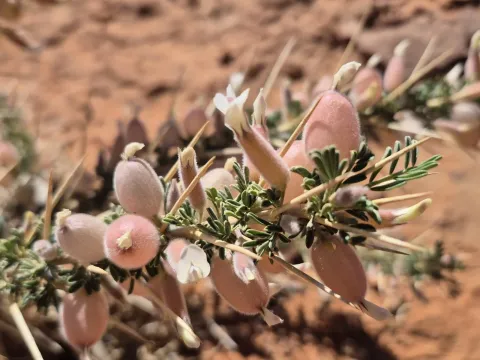
Thorny milkvetch
Astragalus spinosus
Thorny milkvetch (lat. Astragalus spinosus) is a perennial subshrub belonging to the Fabaceae family. This species is highly adapted to the extreme environments of deserts and semi-deserts, specifically within North Africa and the Middle East, serving as a critical xerophytic component of its native ecosystems.
What the section contains
Thorny milkvetch
The plant exhibits distinct botanical characteristics, including a deep taproot system designed to access deep-seated groundwater and modified, spine-like leaf structures that minimize water loss through transpiration. These traits are essential for survival in high-temperature, low-precipitation regions.
Agricultural success with this crop requires well-drained, sandy, or rocky soils. It thrives in high-solar radiation environments and is intolerant of waterlogging, which often leads to root rot. Soils with low fertility are generally sufficient for its establishment and maintenance.
Regarding agrotechnical requirements, the crop demands minimal irrigation, making it suitable for arid land management. Its growth cycle is synchronized with seasonal precipitation, and it displays significant resilience against dramatic diurnal temperature fluctuations.
Effective cultivation requires proper plant spacing to accommodate the physical diameter of the mature plant. As a member of the legume family, it contributes to soil health by fixing atmospheric nitrogen, thereby benefiting the surrounding soil ecosystem in nutrient-poor areas.
The primary economic use of thorny milkvetch lies in forage and ecological restoration. It serves as a resilient fodder source for livestock in desert conditions, as its thorny architecture protects the plant from overgrazing while providing protein-rich biomass.
Environmentally, the species is an excellent tool for soil stabilization and combatting desertification. Its root structure anchors shifting sands, making it a valuable crop for reclaiming degraded land and protecting topsoil from wind erosion.
Pharmaceutical interest in Astragalus spinosus is growing, particularly regarding the extraction of bioactive compounds such as saponins and flavonoids. Traditional applications suggest potential therapeutic uses in promoting general well-being and managing inflammation.
Harvesting strategies must be cautious due to the slow growth rate of the species. Sustainable management practices ensure that harvest intensity does not exceed the plant's capacity for regeneration, preserving long-term population viability.
Seed collection is performed at the end of the reproductive phase. Given the seed's hard-coated nature, industrial-scale propagation necessitates physical or chemical scarification to improve germination rates in large-scale field sowing programs.