
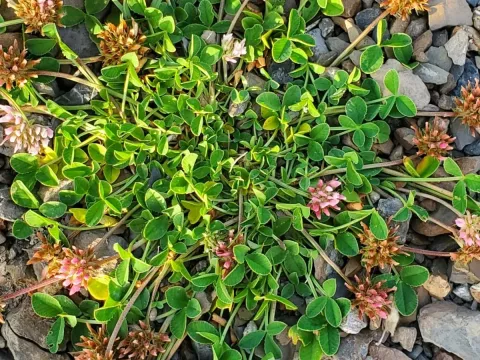
Thal's clover
Trifolium thalii
Thal's clover is an alpine species not typically used in lowland industrial agriculture, meaning its cultivation requires specific knowledge of its high-mountain niche. Natural propagation relies on seeds distributed at the end of the summer season.
What the section contains
Thal's clover
For deliberate cultivation, seeds are sown in prepared soil either before winter or in early spring, following a period of stratification. Ensuring proper soil-to-seed contact is vital, as the hard seed coat requires moisture and a cold period to break dormancy.
Sowing times must align with the local mountain climate to ensure that seedlings establish before extreme temperatures arrive. Seeds should be planted at a shallow depth of approximately 0.5 to 1 cm in a porous, light substrate.
Scarification is a recommended technique to improve germination rates, effectively bypassing the hard seed coat's resistance to water absorption. This is essential for uniform emergence in small-seeded legumes like Trifolium thalii.
Row planting is preferred when cultivating in specialized nurseries or experimental plots. Using precision seeders calibrated for small seeds ensures optimal density and minimizes seed waste during the establishment phase.
As a member of the Fabaceae family, Thal's clover is perfectly adapted to the harsh conditions of the alpine and subalpine zones. It naturally thrives on stony slopes and limestone soils that offer excellent natural drainage.
The culture has strict requirements for soil aeration and is extremely sensitive to waterlogging, which can quickly damage the root system. It is well-adapted to withstand significant diurnal temperature fluctuations and high wind speeds.
Optimal growth occurs in neutral to slightly alkaline soils rich in organic matter. Thal's clover is highly intolerant of competition from taller grass species, making weed control a critical aspect of its management.
The light environment should be intense, mirroring the high levels of ultraviolet radiation found on open mountain slopes. Plants do not tolerate shading, so spacing and site selection are essential for maintaining population health.
Cultivating this species in lowland regions is economically challenging, as it requires artificial cooling and specific soil conditions to prevent heat stress. It is primarily managed as a native component of high-altitude pastures.
The agricultural value of Thal's clover lies in the high nutritional density of its forage for livestock grazing in mountain areas. It forms dense mats that provide high-quality early-season fodder.
Forage biomass yield is highly dependent on the plant density and the composition of the surrounding flora. While total tonnage may be lower than in lowland crops, the nutritional profile is superior for animals grazing in alpine terrains.
Integrating Thal's clover into mountain hay meadows enhances the overall quality of harvested feed. The plant is noted for its ability to regrow rapidly after grazing, which supports sustainable pasture management.
Productivity can be boosted by applying moderate amounts of phosphorus and potassium, which support root system development. Avoiding excess nitrogen is key, as high nitrogen levels can suppress the nitrogen-fixing bacteria residing in the plant's root nodules.
Growth is most active immediately after the snow melts, taking advantage of the high soil moisture levels. By late summer, development naturally slows as the plant enters a physiological stage of cold-hardiness preparation.
The plant is susceptible to common legume diseases, including various rusts and anthracnose, particularly in high-humidity environments. Maintaining good air circulation and preventing site overcrowding are the primary preventative measures.
Weevils and clover seed beetles are the most prominent pests, capable of significantly reducing seed viability if left unchecked. Regular monitoring of the foliage and reproductive structures is required during the growing season.
Root rot often occurs in soils with poor drainage or during prolonged periods of excessive rain. Proper site selection and soil preparation are the best defenses against these soil-borne pathogens.
Viral infections may be transmitted by insect vectors, emphasizing the need for an integrated pest management approach. Maintaining healthy soil biology helps the plant better withstand and recover from pathogen attacks.
Weed competition remains the most significant threat to the successful establishment of Thal's clover. Manual or chemical weeding, combined with appropriate site selection, is essential to keep the crop dominant in its target area.
Seed harvesting is a delicate process that requires careful observation of pod maturity. Seeds should be collected just before the pods begin to naturally shatter, as the small seeds are easily lost to wind and gravity.
For hay production, the optimal harvest time is at the peak of flowering, when the protein concentration in the foliage is at its highest. Harvesting should take place during dry spells to ensure rapid drying.
Drying should occur in well-ventilated conditions to prevent the loss of the delicate, protein-rich leaves. High-quality hay should retain a fresh green color and characteristic legume aroma.
Stored forage must be kept in conditions where moisture levels remain below 17% to prevent spoilage and mold growth. Proper storage ensures the preservation of winter feed quality for livestock.
Post-harvest cleaning of seeds is done using specialized sieves. Given the small size of the seeds, high precision is required to remove debris and unwanted seeds from the harvested material.