
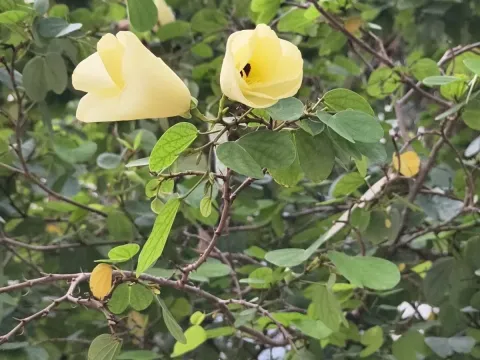
Yellow bell bauhinia
Bauhinia tomentosa
Yellow bell bauhinia (Bauhinia tomentosa) is a perennial shrub belonging to the Fabaceae family. It is widely recognized for its beautiful, bell-shaped yellow flowers that feature a distinctive deep purple or dark maroon blotch at the base.
What the section contains
Yellow bell bauhinia
The plant originates from tropical regions, including India, Southeast Asia, and Africa. In its native habitat, it grows as an understory shrub, thriving in warm climates with high humidity levels and consistent sunlight exposure.
For successful cultivation, the plant requires well-drained, fertile soil with a slightly acidic to neutral pH. It is crucial to prevent waterlogging, as the species is highly susceptible to root damage when kept in saturated soil conditions.
The optimal thermal range for growth is between 20°C and 28°C. In regions with cooler winters, the plant must be kept in greenhouses or indoors, as it cannot withstand frost or freezing temperatures.
Agrotechnical management involves regular pruning to encourage branching and improve flowering density. Fertilizing with balanced nutrients during the active growing season significantly enhances plant vigor and flower production.
The harvesting of medicinal plant parts such as flowers, bark, and roots is typically done manually. Bark is harvested sustainably from older stems to avoid stressing the plant, while flowers are collected at full bloom for maximum chemical yield.
The plant is susceptible to common greenhouse pests, particularly spider mites and whiteflies. These insects thrive in dry environments and can cause significant foliage damage if left uncontrolled.
Fungal infections, such as leaf spot and root rot, are the most prevalent diseases. Maintaining proper airflow and adhering to strict watering regimes are effective preventive measures against these pathogens.