
Xeroderris
Xeroderris
Xeroderris, specifically Xeroderris stuhlmannii, is a leguminous tree species that naturally propagates through seeds found in its flat, woody pods.
What the section contains

Xeroderris
To cultivate the species, seeds must be harvested upon maturity and treated with scarification to overcome their hard seed coat dormancy.
Nursery propagation is recommended, where seeds are sown in nutrient-rich media to ensure strong seedling development before outplanting.
Field transplanting is typically scheduled at the onset of the rainy season to provide the saplings with adequate moisture for establishment.
Spacing during planting should be generous to allow for the natural, spreading canopy characteristic of mature Xeroderris trees in the wild.
This tree is native to tropical Africa and is well-adapted to savanna environments that experience distinct wet and dry seasonal cycles.
Xeroderris thrives in deep, well-draining sandy or loamy soils and is generally intolerant of waterlogged conditions or heavy clay soils.
It is highly drought-resistant, a trait that allows it to survive in regions with prolonged dry seasons and significant heat stress.
Full solar exposure is essential for the tree's health, as it is a light-demanding species that struggles to survive under a dense forest canopy.
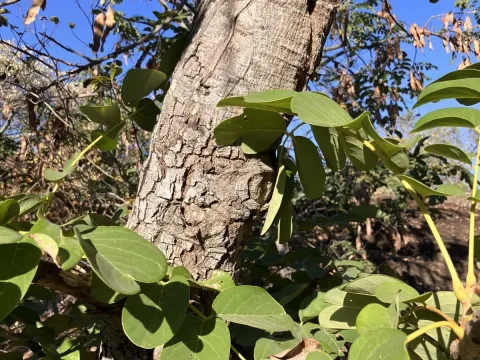
The tree exhibits natural resistance to the frequent fires that occur in its native habitat, utilizing its robust bark as a protective barrier.
The primary economic value of Xeroderris lies in its timber, which is highly sought after for furniture making, construction, and carving.
Its wood is recognized for its impressive durability, hardness, and natural resistance to rot and insect infestation, making it very valuable.
Beyond timber, the tree has traditional medicinal uses, with its bark and roots serving as ingredients for various local health remedies.
The tree's foliage can provide forage for wildlife and domestic livestock, particularly during the transition between dry and wet seasons.
As a legume, it contributes to soil fertility through nitrogen fixation, playing a beneficial role in local agroforestry and ecosystem health.
The major threat to the species is over-harvesting for its high-quality timber, which has led to population declines in several regions.
Seedlings and young saplings are particularly susceptible to browsing by cattle and goats, which limits natural forest regeneration.
Fungal infections may occur in managed settings if air circulation is poor or if the soil drainage is not properly maintained.
Various bark-boring insects pose a secondary risk, potentially weakening older trees and making them vulnerable to secondary infections.
Habitat fragmentation due to land conversion for agriculture presents a long-term challenge to the survival of wild Xeroderris populations.